

 Sasha Campbell
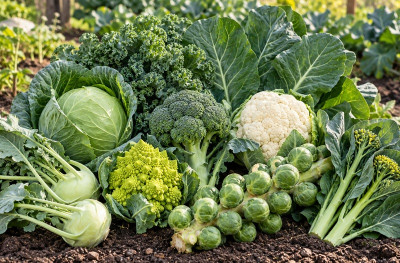
Cabbage, kale, broccoli, and cauliflower may look very different. However, they all belong to the same plant species: Brassica oleracea.
For thousands of years, people saved seeds from plants with useful features. Some plants had large leaves. Others had thick stems, tight heads, or large flower buds. This careful selection slowly produced many of the vegetables we eat today.
There are many cultivated forms of Brassica oleracea to explore. Each one has its own shape, flavor, and use in the kitchen. Most are cool-season crops that grow well during the cooler parts of spring and fall.
What Is Brassica oleracea?
Brassica oleracea is a plant species in the mustard family. Its wild form is often called wild cabbage.
Wild cabbage grows naturally along parts of the Atlantic coast of Great Britain, France, and Spain. People have grown and selected forms of this plant for at least 2,000 years [1].
Wild cabbage does not look exactly like the vegetables in a grocery store. It has thick, fleshy leaves that help it hold water and nutrients.
Over time, growers chose plants with certain traits. They saved seeds from plants with the largest leaves, thickest stems, firmest heads, or biggest flower buds.
This process created several cultivar groups from one plant species. Gardeners often call them varieties. Plant experts usually place them into groups called cultivar groups.
These vegetables are also known as cole crops or brassicas. They usually prefer fertile soil, steady moisture, and cool weather.
9 Types of Brassica oleracea to Grow
The following vegetables all came from wild cabbage. Each type was developed for a different feature, such as its leaves, stem, buds, or flower head.
1. Kale
Kale belongs mainly to the Acephala Group. The word “acephala” means “without a head.” Unlike cabbage, kale produces open leaves instead of forming a tight, round head.
There are many types of kale. Curly kale has ruffled leaves and a fairly strong flavor. Lacinato kale has long, dark leaves with a bumpy surface. It is also called dinosaur kale or Tuscan kale. Scotch kale has tightly curled, blue-green leaves.
Red Russian kale is sometimes grouped with other kales in seed catalogs. However, it belongs to a different species called Brassica napus, so it is not included here [2].
Kale is one of the most cold-tolerant forms of Brassica oleracea. Cool weather can help make its leaves taste sweeter. You can eat young leaves raw or cook older leaves in soups, stews, and stir-fries.
2. Collard Greens
Collard greens also belong to the Acephala Group. They produce large, broad leaves around an upright stem.
The leaves are usually smooth and blue-green. They have a mild, cabbage-like flavor. Unlike many types of kale, collard leaves are not normally curled.
Collard greens can handle warmer conditions better than many other cole crops. However, they still grow best during mild or cool weather. The plants can become quite large, so give them plenty of room.
People often cook collard leaves slowly until they become tender. Young leaves can also be chopped and added to salads.
3. Cabbage
Cabbage belongs to the Capitata Group. It forms a firm head made of many overlapping leaves.
Green cabbage is one of the most common types. It normally has smooth leaves and a round head. Red cabbage has purple or reddish leaves. Savoy cabbage produces softer, wrinkled leaves and often has a mild flavor.
Some cabbages form pointed heads, while others are round or flat. Their growing times also vary. Early varieties mature quickly, while storage varieties take longer to grow. Some storage cabbages can last for months when kept under the right conditions.
Cabbage can be eaten raw, cooked, pickled, or fermented.
4. Broccoli
Broccoli is commonly placed in the Italica Group. We usually eat the tender stems and unopened flower buds.
The main head grows at the top of the plant. After you harvest it, many varieties produce smaller side shoots. These shoots may provide additional harvests for several weeks.
Calabrese broccoli is the familiar type with a large green head. Sprouting broccoli produces many smaller shoots instead of one large head. Purple sprouting broccoli often needs a long growing season. In mild climates, you may plant it one year and harvest after winter.
Harvest broccoli while the flower buds are firm and tightly closed. If you wait too long, small yellow flowers will begin to open. The flowers are edible, but the stems and buds may become tougher.
5. Cauliflower
Cauliflower is commonly placed in the Botrytis Group. It produces a firm head called a curd. This curd is made of many tightly packed, undeveloped flowering shoots.
White cauliflower is the best-known type. However, you can also find purple, orange, and green varieties. These colors are natural and depend on the variety.
Cauliflower needs steady growing conditions. Too much heat, cold, or stress may cause the plant to form a small or uneven head.
For some white varieties, fold the outer leaves over the curd. Gardeners call this process blanching. The leaves block sunlight and help the head stay white. Other varieties naturally grow leaves over their heads.
You can roast, steam, mash, or eat cauliflower raw.
6. Romanesco
Romanesco belongs to the same Botrytis Group as cauliflower. People often call it Romanesco broccoli, but it grows and looks more like cauliflower.
Many pointed spirals form its green head. Each spiral contains smaller points that repeat the same pattern. This striking design makes Romanesco one of the most unusual vegetables in the garden.
Romanesco has a mild, slightly nutty flavor. Its texture becomes tender but stays firm when cooked. You can roast, steam, or boil it.
Like cauliflower, Romanesco grows best when the weather stays cool and even.
7. Brussels Sprouts
Brussels sprouts belong to the Gemmifera Group. Instead of making one large head, the plant forms many small, cabbage-like buds along a tall stem.
Each sprout grows where a leaf joins the main stem. The sprouts near the bottom usually mature first [3].
You can pick the sprouts one at a time as they become firm. You can also cut the whole stalk when most of them are ready.
Brussels sprouts need a long growing season. They often taste sweeter after cool weather or a light frost. Hot weather can cause the sprouts to become loose instead of forming tight buds.
Roasting helps bring out their sweet and nutty flavor.
8. Kohlrabi
Kohlrabi belongs to the Gongylodes Group. Its name means “cabbage turnip,” but it is not a true turnip.
The round part grows above the soil. It is a swollen stem rather than a root. Kohlrabi may be pale green, white, or purple on the outside. The inside is usually pale.
Young kohlrabi has a crisp texture and a mild, sweet flavor. It tastes a little like a mix of cabbage stem, broccoli, and radish.
Large, swollen stems may become tough or woody. Harvest them while they are still young and tender. You can eat the swollen stem raw or cooked. The leaves are also edible.
9. Chinese Broccoli
Chinese broccoli is also called gai lan, kai lan, or Chinese kale. It belongs to the Alboglabra Group of Brassica oleracea. Chinese broccoli is one of the recognized cultivated forms of this species [4].
It produces thick stems, flat blue-green leaves, and small flower buds. The stems, leaves, buds, and flowers are edible.
Chinese broccoli has a slightly bitter flavor that becomes milder when cooked. It is often steamed, boiled, or stir-fried.
Harvest the stems while they are young and tender. Older stems may become tough. This crop grows fairly quickly in cool weather, making it useful for small gardens.
How to Grow Brassica oleracea Varieties
Most cole crops grow best in full sun and fertile, well-drained soil. Mix compost into the soil before planting. Keep the ground evenly moist, especially while heads, stems, or flower buds are forming.
These vegetables generally prefer cool weather. Gardeners in cooler areas often plant them in early spring or late summer. In hot areas, they may grow better from fall through winter.
The correct planting time depends on your climate and the variety you choose.
Common pests include imported cabbageworms, cabbage loopers, diamondback moth caterpillars, aphids, flea beetles, and slugs. Check both sides of the leaves often. Young plants are especially at risk from caterpillar damage [5].
Lightweight row covers can help keep many flying pests away from the plants. Place the covers over the crops soon after planting. Make sure the edges are held tightly against the ground.
Crop rotation may also reduce problems with certain pests and diseases. If possible, wait four years before growing cabbage-family crops in the same bed again [2].
Remember to include broccoli, cabbage, cauliflower, Brussels sprouts, kale, collards, mustard, turnip, and rutabaga in your rotation plan. They belong to the wider cabbage family and may share some of the same pests and diseases.
Where to Buy Brassica oleracea Seeds
You can buy these seeds from garden centers, farm stores, seed companies, and online shops. Choose a trusted seller and check the growing time, climate needs, and shipping rules before buying.
Choosing the Best Variety
Choose your crop based on your weather, garden space, and cooking needs.
Kale, kohlrabi, and Chinese broccoli are useful when you want a fairly quick harvest. Cabbage and cauliflower may need more room. Brussels sprouts also need plenty of space and a long period of cool weather.
Always check the seed packet before planting. It should tell you how much space the plants need and about how long they take to mature.
No matter which type you choose, you are growing a special form of the same remarkable species. The many Brassica oleracea varieties show how one wild plant became an entire family of useful and delicious vegetables.




[…] beetles are small jumping beetles that feed on many crops in the garden. They mainly feed on brassicas and related […]