

 Sasha Campbell
Curly dock is a plant that many people walk past without noticing. It often grows in fields, pastures, gardens, ditches, roadsides, and other places where the soil has been disturbed.
Also called yellow dock, sour dock, narrow-leaved dock, and curled dock, curly dock (Rumex crispus) belongs to the buckwheat family. It is native to Europe but now grows across North America and many other parts of the world [1].
Many gardeners see curly dock as a weed. It has a strong taproot, produces thousands of seeds, and can compete with garden plants for water, nutrients, light, and space.
However, young curly dock leaves have a history of use as wild food. They must be identified correctly and eaten with care because the plant contains oxalates.
Here is how to identify, harvest, prepare, and safely control curly dock.
What Does Curly Dock Look Like?
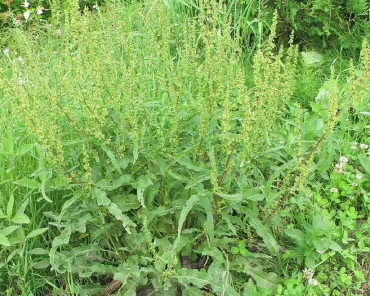
Curly dock first grows as a low circle of leaves. This circle is called a rosette.
The leaves are long and narrow. Most mature leaves are about 6 to 12 inches long. They have strongly wavy or curled edges, which give the plant its name.
The leaves are usually green, smooth, and hairless. Older leaves may develop red or purple coloring.
Wavy leaves are a helpful clue, but you should never identify a wild plant from one feature alone.
Look for the Papery Leaf Sheath
Curly dock has a thin, papery covering where each leaf joins the stem.
This covering is called an ocrea. It wraps around the stem and is a useful identification feature.
Young plants can be harder to identify because their first leaves are not always strongly curled. If you are unsure, check the plant again as it grows.
Look for the Tall Flower Stalk
As curly dock grows, it sends up a tall flower stalk from the center of the rosette.
A mature plant may grow from 2 to 5 feet tall. The stem is often smooth, ridged, and slightly reddish.
Small green or reddish flowers grow in clusters along the upper part of the stalk. The flowers are not bright or showy.
Later, the flower clusters turn rusty brown as the fruits mature. These brown stalks may remain standing during winter. Their color makes older plants easy to spot [2].
Curly Dock Has a Deep Taproot
Curly dock grows from a large taproot.
The root is usually yellowish inside. This may be one reason the plant is commonly called yellow dock.
The root stores energy and helps the plant survive dry weather and cold temperatures. If the leaves are cut off, the plant may grow again from buds near the top of the root.
This strong root also makes mature plants difficult to remove.
Curly Dock Is a Perennial
Curly dock is a perennial. This means an established plant can live for more than two years.
The flower stalk may die at the end of the growing season, but the root can remain alive underground. New leaves may then grow from the root crown.
Curly dock also spreads by seed. Its strong root and long-lasting seeds help it survive in many places.
Where Does Curly Dock Grow?
Curly dock can grow in many types of soil.
You may find it in:
- Fields
- Pastures
- Orchards
- Ditches
- Lawns
- Roadsides
- Garden beds
- Waste areas
- Wet or disturbed ground
It often grows well in rich, heavy, damp soil. It may also appear in places that are overwatered or have poor drainage.
However, established plants can survive in dry and poor soil too.
What Curly Dock May Tell You About Your Soil
One curly dock plant cannot tell you everything about your soil. A large patch, however, may show that an area needs attention.
Curly dock is often found in wet soil and low areas where water collects. It may also grow in compacted or disturbed ground.
If the plant keeps returning to the same garden bed, check for:
- Standing water
- Poor drainage
- Heavy soil
- Too much watering
- Bare or disturbed soil
- Soil compaction
Don’t assume curly dock is fixing these problems. Its presence only shows that it can survive there.
A soil test and a close look at the drainage will give you better information.
Curly Dock and Animals
Some insects feed on curly dock leaves. Its seeds may also be carried to new places by water, wind, animals, tools, and farm equipment.
However, curly dock should not be treated as safe livestock feed. It contains oxalates and may collect nitrates. Large amounts can harm grazing animals.
UC Statewide IPM warns that curly dock may poison livestock when animals eat it in large quantities [2].
If you keep livestock, do not assume that a plant is safe simply because people have eaten small amounts of it.
Nutrients in Curly Dock
Curly dock contains vitamins and minerals found in other leafy green plants.
One laboratory study found vitamin C, iron, calcium, magnesium, and potassium in curly dock leaves. However, the amounts may differ from one plant to another [3].
Nutrient levels may change based on the soil, weather, season, plant age, and preparation method.
Curly dock should not be treated as a special health food. It contains oxalates, which can affect how well the body uses certain minerals.
For this reason, eating more is not always better.
What Does Curly Dock Taste Like?
Young curly dock leaves have a tart or slightly sour taste.
This sharp flavor is one reason the plant is sometimes called sour dock.
As the leaves grow older, they usually become tougher, more bitter, and less pleasant to eat. If you choose to harvest curly dock, select only young, tender leaves.
Which Parts of Curly Dock Are Edible?
Some foragers eat small amounts of properly identified young leaves.
The leaves are usually gathered before the plant produces its tall flower stalk. Older leaves are often too tough or bitter to enjoy.
Curly dock seeds have also been used as food in some foraging traditions. However, they take more time to collect, clean, and process.
For beginners, young leaves are the easiest part to prepare. Never eat any part of the plant unless you are completely sure of its identity.
How to Harvest Curly Dock Leaves
Choose young, fresh leaves from a plant you have correctly identified.
Avoid leaves that are:
- Old or tough
- Yellow or badly damaged
- Covered with spots
- Diseased
- Heavily eaten by insects
Pay close attention to where the plant is growing.
Do not collect curly dock from:
- Busy roadsides
- Sprayed farm fields
- Chemically treated lawns
- Industrial sites
- Old dumping areas
- Places used by many pets
- Soil that may contain harmful chemicals
Plants can take up unwanted substances from polluted soil. Dust and chemicals may also settle on their leaves.
Wash the leaves well under clean running water before cooking them.
How to Prepare Curly Dock
Young curly dock leaves can be cooked like other leafy greens.
Boiling is one useful method because some soluble oxalates can move into the cooking water. Studies of high-oxalate vegetables show that boiling can lower soluble oxalate levels [4].
Place the leaves in plenty of water and boil them until tender. Pour away the cooking water. Do not use that water in soups, sauces, or drinks.
Boiling may lower some oxalates, but it does not remove all of them. It also does not make curly dock safe to eat in unlimited amounts.
Cooked curly dock leaves may be added to:
- Soups
- Stews
- Egg dishes
- Rice dishes
- Mixed vegetables
- Savory pies
Try only a small serving the first time.
A Warning About Oxalates
Curly dock contains oxalates. Many other plants also contain these natural compounds, including spinach, beet greens, and Swiss chard.
Oxalates can bind with calcium. A health professional may advise people who develop calcium-oxalate kidney stones to limit foods high in oxalates.
Eat curly dock only occasionally. Avoid large servings, and do not use it as an everyday vegetable.
People with kidney disease, kidney stones, or instructions to follow a low-oxalate diet should speak with a qualified health professional before eating curly dock.
Pregnant or nursing people, young children, and anyone with a health condition should get medical advice before eating unfamiliar wild plants.
Stop eating curly dock and seek medical help if you feel sick after eating it.
Curly Dock vs. Broadleaf Dock
Curly dock can be confused with other plants in the Rumex group.
One common look-alike is broadleaf dock (Rumex obtusifolius).
Curly dock usually has:
- Long, narrow leaves
- Strongly curled or wavy edges
- A tapered leaf base
- A taproot with few branches
Broadleaf dock usually has:
- Wider leaves
- Flatter or less wavy edges
- A rounded or heart-shaped leaf base
- A more branched taproot
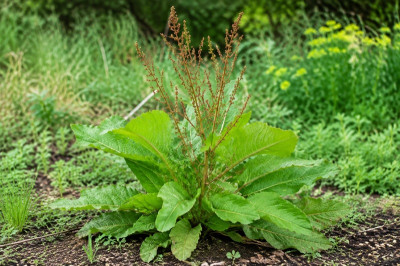
Picture of Broadleaf dock (Rumex obtusifolius).
Both plants may have a papery sheath where the leaf joins the stem.
Do not identify either plant from its leaves alone. Check the leaf shape, stem, root, flowers, fruits, and growth pattern.
If you are unsure, ask an experienced local forager or plant expert. A phone app should not be your only identification method.
Curly Dock Produces Many Seeds
Curly dock can produce many seeds.
University of Maryland Extension reports that one plant may produce from 100 to 60,000 seeds. Under suitable conditions, some seeds may remain alive in the soil for up to 80 years [5].
The small fruits are smooth, shiny, reddish-brown, and three-sided. Each fruit is surrounded by a papery, three-winged covering.
Wind and water can carry them to new places. They may also move in soil, hay, animal waste, shoes, tools, or farm equipment.
Old seeds may sprout after the soil is dug or tilled. Digging can bring buried seeds closer to the surface, where they may receive enough light and warmth to grow.
Should You Grow Curly Dock on Purpose?
For most gardeners, there is little reason to plant curly dock in a vegetable bed.
The plant already spreads easily. Once established, its large taproot can make removal difficult. Allowing it to mature may add thousands of seeds to the soil.
Curly dock is also treated as a troublesome or noxious weed in some places. Check local weed rules before planting it or allowing it to spread.
If curly dock already grows on your property and you want to harvest a few young leaves, keep the plants under close control. Remove the flower stalks before the fruits turn brown and mature.
How to Control Curly Dock Naturally
Young plants are easier to remove than mature ones.
Water the soil lightly or wait until after rain. Moist soil can make pulling easier.
Use a digging fork or narrow weeding tool to loosen the ground around the root. Try to remove the root crown and as much of the taproot as possible.
Pulling off only the leaves will not kill an established plant. New leaves can grow from the root crown.
Cutting flower stalks before the seeds mature can stop that crop of seeds. However, one cutting may not be enough. Curly dock may grow new leaves and flower stalks, so check the area often.
Repeated cutting may weaken the plant and stop it from making seeds. However, cutting alone may not kill the deep root.
After removing curly dock, cover the bare ground with mulch or healthy garden plants. This makes it harder for new seedlings to grow.
Can Curly Dock Go in Compost?
You can add young leaves and stems that have not produced seeds to a well-managed compost pile.
Be careful with mature seed heads. Many home compost piles do not become hot enough to kill weed seeds.
Living root crowns can also survive if the compost pile stays cool or damp.
To prevent curly dock from spreading:
- Keep mature seed heads out of ordinary compost
- Remove soil from the roots
- Let young roots dry completely in the sun
- Keep thick roots and living crowns out of cool compost piles
- Use only plant material that has no mature seeds
If your area lists curly dock as a noxious weed, follow your local disposal rules.
Takeaway
Curly dock is a common perennial weed with long, narrow leaves and strongly wavy edges. It also has a papery covering around the stem, a large yellowish taproot, and tall stalks that turn rusty brown.
Some foragers cook and eat small amounts of the young leaves. However, correct identification is very important. Cook curly dock before eating it, and eat it only in moderation because it contains oxalates.
In the garden, its deep root and long-lasting seeds make it difficult to control. Remove young plants early and cut flower stalks before the seeds mature.




Add comment