

 Sasha Campbell
Once you spot one Colorado potato beetle, there may be more hiding in your garden. Some gardeners call them potato bugs, but their proper common name is Colorado potato beetle.
They are difficult pests to control and can cause serious damage to potato plants [1]. Their larvae are especially destructive because they eat large amounts of leaves.
In severe infestations, Colorado potato beetles can cause major crop losses, especially when they are not controlled early. As a result, we will discuss how to get rid of Colorado potato beetles, their larvae, and eggs.
Identification
The Colorado potato beetle (Leptinotarsa decemlineata) became well known as a serious potato pest in Colorado, which is where it got its common name [2].
They are commonly called Colorado potato beetles, though some people also refer to them as potato bugs.
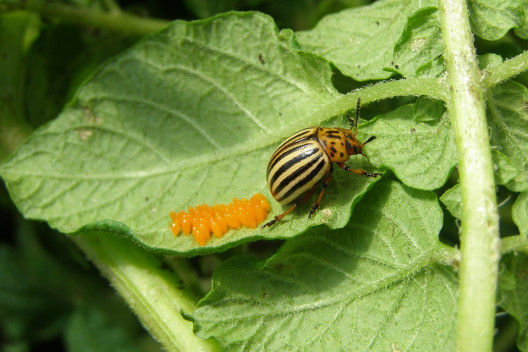
An adult has a round, orange-yellow body and ten black stripes on its wing covers. These stripes give it the nickname “ten-lined potato beetle.”
How to Get Rid of Colorado Potato Beetles Naturally
Before heading for store-bought pesticides, try home remedies and organic approaches to control Colorado potato beetles.
The most effective approach combines prevention, manual removal, and carefully chosen organic treatments.
1. Crop Rotation
Rotating crops is a simple way to help reduce Colorado potato beetle problems.
Rotate potatoes and related crops every three to four years. This can reduce beetle problems, but it works best when combined with other control methods.
2. Row Covers
These covers protect plants from certain pests. They prevent flying insect pests from landing on your plants and causing damage.
Place row covers over young plants before beetles appear. Make sure the edges are sealed so beetles cannot crawl underneath.
Remove them when plants begin flowering so pollinators can reach the flowers. Check your plants often after removing the covers because beetles can still find them later in the season.
3. Repellent Plants
Using plants to support pest control is one approach many organic gardeners try.
Some gardeners plant tansy, coriander, marigolds, nasturtiums, and catnip near potatoes. These plants may help attract helpful insects and add diversity to the garden, but they are not guaranteed to repel Colorado potato beetles.
4. Soap and Water
You can also use soapy water to manage Colorado potato beetle populations in the garden.
Fill a bucket with water and add a small amount of liquid soap. Knock the beetles into the bucket, where the soapy water will kill them.
Avoid spraying strong soap solutions directly on plants, as they may damage leaves.
5. Mulch
Mulching helps conserve soil moisture, control weeds, and create a better environment for plants. It may also support beneficial insects, including ground predators that feed on some garden pests.
Straw is one of the most popular and effective organic mulches, but others will work just as well.
6. Handpicking
Handpicking is an organic, cost-effective method for reducing Colorado potato beetle numbers.
Put on gloves. Then, pick off the beetles. Check the undersides of the leaves. That is where adults often lay their eggs and where young larvae feed.
Either squish them underfoot or throw them into a pail of soapy water.
7. Trap Crops
In addition to companion plants, you can use trap crops to concentrate beetles in one area, making them easier to monitor and remove.
Colorado potato beetles strongly prefer potatoes and may also feed on related plants like tomatoes and eggplants.
However, trap cropping works best with careful management. If not monitored, beetles can still move back into the main crop.
8. Natural Predators
Some natural enemies can help reduce Colorado potato beetle populations in your garden.
Among the potato beetle predators are:
- Ladybugs
- Predatory stink bugs
- Green Lacewings
- Some parasitic wasps
- Damsel bugs
- Some birds
Many natural predators target eggs and young larvae rather than adult beetles.
9. Garlic Spray
Garlic may act as a natural repellent that helps deter Colorado potato beetles. It contains sulfur compounds that may make plants less attractive to some pests.
To make a homemade spray for Colorado potato beetles, blend 4 to 5 cloves of garlic in 2 cups of water. Strain the mixture, then add 1 teaspoon of liquid soap to help it stick to plant leaves.
Spray directly on the leaves, especially the undersides where beetles and larvae are commonly found. Reapply after rain or as needed because homemade sprays usually do not last long on leaves.
10. Destroy Eggs
These beetles lay their eggs underneath the leaves of their target plants. So, check the undersides of leaves for yellow-orange egg clusters.
Remove the eggs by crushing them or rubbing them off before they hatch.
11. Diatomaceous Earth
Diatomaceous earth (DE) can kill many crawling insects when they crawl over it under dry conditions.
It may kill Colorado potato beetles and larvae when they crawl across it. It works best when it remains dry because moisture reduces its effectiveness.
Sprinkle it on your plants, targeting the areas where the beetles are likely to crawl.
You can also apply diatomaceous earth directly to plant leaves as a dry dust. Reapply after rain or watering.
Use food-grade DE for garden pest control when appropriate, but avoid breathing the dust during application.
12. Spinosad
Spinosad is one organic insecticide that can help control Colorado potato beetles.
It paralyzes the nervous systems of larvae and mature bugs. It eventually cripples and kills them.
However, spinosad can also harm bees and other beneficial insects, so avoid spraying when pollinators are active.
Apply in the evening when bees are less active for added safety.
13. Neem Oil
This oil is an extract from neem seeds. It is a commonly used organic option for helping control potato beetles.
Neem oil can also help control several other insect pests organically. You can use it as a store-bought concentrated solution.
You can make a neem oil spray by following the product label directions. Many homemade mixtures use neem oil combined with water and a small amount of liquid soap to help it mix.
Neem oil can help control Colorado potato beetles by affecting their feeding and growth. It works best when applied early, especially against young larvae.
Takeaway
Most of the methods mentioned above for controlling Colorado potato beetles are commonly used in organic gardening. However, effectiveness varies depending on conditions and application.
Start control methods early, as young larvae can quickly consume large amounts of plant foliage and weaken your plants.



Add comment