

 Sasha Campbell
Fire blight is a contagious and destructive bacterial disease.
It can affect many fruit trees and ornamental plants. It can also spread quickly if not managed appropriately.
The good news is that there are natural ways to manage and even prevent fire blight. In this article, we will explore natural ways to help prevent and manage fire blight.
Identification
Fire blight is caused by the bacterium Erwinia amylovora. It infects plants via blossoms, stem wounds, and leaves [1], [2].
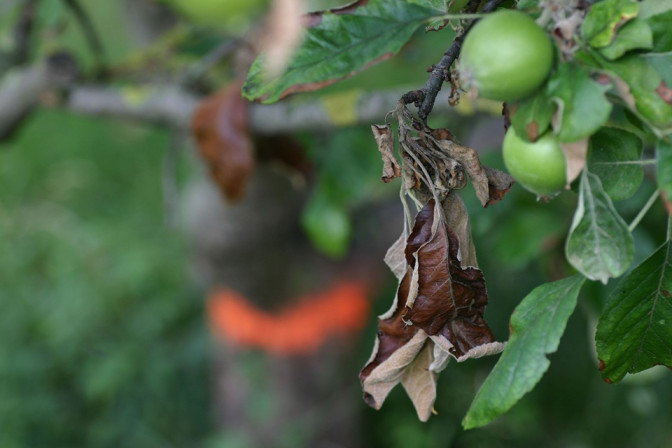
This disease often gives branches a scorched look, turning them brown to black. That’s where the name fire blight comes from.
Young leaves and shoots also wither and bend downwards, creating a hook-like appearance [3]. In severe cases, the disease can kill an entire branch or even the whole tree.
In humid spring weather, infected blossoms may ooze a sticky, amber-colored bacterial substance. This ooze can spread the disease [4].
Fire blight primarily affects members of the Rosaceae family. Common hosts are apples, pears, quinces, and loquats. Other susceptible plants include roses, crabapples, hawthorns, cotoneasters, and other members of the rose family.
Apple and pear trees are particularly susceptible. Commercial orchards often face significant losses if the disease is not controlled.
How to Get Rid of Fire Blight Naturally
Here are some top home remedies and natural solutions to help control this disease.
1. Pruning
One of the most effective natural ways to control fire blight is through careful pruning.
Remove infected branches and twigs. Doing so can prevent the disease from spreading further into the tree.
Prune at least 8 to 12 inches (20 to 30 cm) below visible symptoms. Dispose of diseased wood by burning where permitted or by sealing and discarding it according to local regulations.
2. Avoid Overhead Irrigation
Fire blight bacteria spread more readily during warm, humid weather. Overhead irrigation can also help spread the disease.
Water that splashes on flowers and shoots can spread bacteria. It can transfer them from one part of the tree to another or to nearby plants.
Using drip irrigation or soaker hoses keeps leaves dry while watering the plants’ roots.
3. Sterilize Tools
Pruning tools are a common way for many plant diseases to spread from plant to plant.
Bacteria can linger on shears, loppers, and saws. When these tools are used on healthy plants, they can spread infections.
Therefore, disinfect pruning tools regularly and whenever moving between infected and healthy branches.
Use rubbing alcohol, a 10% bleach solution, or a commercial disinfectant. Doing so can reduce the risk of spreading fire blight.
4. Choose Resistant Varieties
When planting new fruit trees, select cultivars known for their resistance to fire blight. Resistant varieties are often the most effective long-term defense against this disease.
5. Control Aphids and Other Insects
Insects such as aphids and leafhoppers can help spread fire blight from plant to plant.
Natural methods, such as encouraging beneficial insects, can help keep pest populations in check. Spraying with insecticidal soap or neem oil also helps manage garden pests organically.
6. Neem Oil
Neem oil may indirectly help reduce the spread of fire blight by controlling certain insect pests that can move bacteria between plants.
Applying neem oil as a foliar spray during the growing season may help reduce aphid and other pest populations.
Neem oil has mild antifungal properties. This helps control secondary infections that often come with fire blight.
Make a homemade neem oil spray by combining 5 ml of neem oil, 2 ml of liquid soap, and a liter of water. Shake well, then spray your plants with the solution.
Use the recipe as a guide to make a larger batch for spraying your trees.
7. Avoid Excessive Nitrogen Fertilizer
Too much nitrogen fertilizer causes quick, soft growth. This growth is more likely to get fire blight.
Young, tender shoots are also the preferred sites for bacterial invasion.
Therefore, use a balanced fertilizer and avoid heavy nitrogen applications to susceptible plants.
8. Arber Bio Fungicide
Some gardeners use biofungicides as part of an integrated disease-management program. They may help suppress disease-causing organisms and support overall plant health.
Arber Bio Fungicide is a natural, bio-based product. For the best results, follow the directions on the product label. Also, use it together with other fire blight management practices.
9. BONIDE Revitalize Biofungicide
BONIDE Revitalize Biofungicide is another bio-based product. Some gardeners include it in their fire blight management program.
Like other biofungicides, it promotes plant health by enhancing natural disease resistance.
This product works best when used with other methods, such as pruning and pest control. Together, they help manage fire blight effectively.
10. BONIDE Copper Fungicide Dust
Copper fungicides are primarily used as preventative treatments. They may help reduce new infections when applied before or during periods favorable for disease development [5].
BONIDE Copper Fungicide Dust is also a popular choice for helping to prevent bacterial and fungal diseases. When used carefully, it may help prevent fire blight on blossoms and young shoots.
Copper fungicide dust works best when applied at the first signs of bloom or early shoot growth. However, use it sparingly and follow the label instructions.
Takeaway
Once plant tissue becomes infected, there is no cure for fire blight. However, proper pruning, sanitation, and preventive measures can help limit its spread and protect healthy growth.
You can also manage it using natural remedies, such as those listed above.





Azomite applied post bloom, will prevent fire plight. I have used azomite in the early spring with great success. Yes, volcanic ash has very low numbers BUT builds tree immunity.