

 Sasha Campbell
Hairy bittercress may look like a small garden weed, but it has more to offer than many gardeners realize. This fast-growing plant is edible and easy to recognize once you learn its main features. Its early flowers can also provide food for some insects.
Hairy bittercress (Cardamine hirsuta) belongs to the mustard family, Brassicaceae. This makes it a relative of cabbage, broccoli, kale, radishes, and mustard greens. It is native to Europe and Asia but now grows in many other parts of the world [1].
Many gardeners remove hairy bittercress as soon as they see it. This is understandable because the plant can spread very quickly. However, if it grows in a clean, untreated place, you may choose to harvest its young leaves as an edible green.
What Is Hairy Bittercress?
Hairy bittercress is a small, low-growing plant. It is mainly a winter annual. This means its seeds often sprout in fall or winter, and the young plants begin growing faster when warmer spring weather arrives.
In some places, it may also grow as a summer annual or behave like a biennial. A biennial is a plant that lives through parts of two growing seasons. Its exact life cycle depends on the local climate.
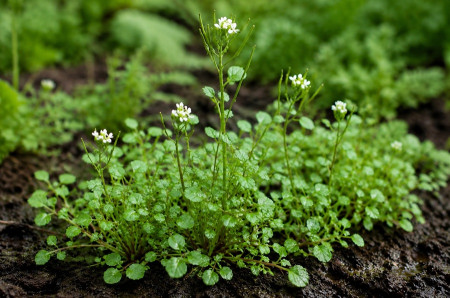
The plant usually forms a basal rosette. This is a low circle of green leaves growing close to the soil. Later, thin flower stems rise from the center.
Although “hairy” is part of its name, the plant does not look very fuzzy. Its tiny hairs can be difficult to see.
Other Names for Hairy Bittercress
You may hear hairy bittercress called bittercress, flick weed, lamb’s cress, land cress, shot weed, springcress, or hoary bittercress.
Names such as “shot weed” and “flick weed” describe the way the plant throws its seeds.
Common names can describe more than one kind of plant. Use the scientific name, Cardamine hirsuta, when checking its identity.
How to Identify Hairy Bittercress
Start by looking at the leaves. They grow in a low circle near the ground. Each leaf is divided into several small, rounded leaflets. The leaflet at the end is usually larger than the others.
As the plant gets older, thin stems grow upward from the center. These stems are often about 3 to 10 inches tall.
Tiny hairs may appear on the leaves and lower stems, but you may need a magnifying glass to see them.
Hairy Bittercress Flowers
Hairy bittercress produces clusters of tiny white flowers near the tops of its stems. Each flower normally has four petals arranged in the shape of a cross.
These four-petaled flowers are another sign that the plant belongs to the mustard family.
Look for the Long Seed Pods
After flowering, hairy bittercress develops narrow seed pods called siliques. The pods point upward and often rise above the flowers.
When the pods mature and dry, they can suddenly split open. This throws seeds several feet away from the parent plant. A single plant may produce hundreds of seeds [1].
If you have touched a bittercress plant and had tiny seeds fly toward you, you have seen this method in action.
Do Not Rely on One Feature
Hairy bittercress can look like other small plants in the mustard family. Do not identify it by its leaves alone.
Check the low circle of divided leaves, larger end leaflets, small white flowers, and thin upright seed pods. If you are not completely sure what the plant is, do not eat it. Ask an experienced local forager or plant expert for help.
Where Does Hairy Bittercress Grow?
Hairy bittercress commonly grows in lawns, vegetable gardens, flower beds, pathways, containers, nurseries, and other places where the soil has been disturbed.
It prefers moist soil and can grow in full sun or partial shade. Thin lawns and bare garden soil give its seeds plenty of room to sprout. You may also find it in pots bought from garden centers.
When Does Hairy Bittercress Grow?
In many places with mild or cold winters, hairy bittercress is most noticeable during the cooler months.
Seeds may sprout in fall or winter. The small plants can live through cold weather and grow during mild periods. When spring arrives, they can grow, flower, and produce seeds very quickly. Hot weather usually causes winter-growing plants to decline.
Its growing season will change depending on the local climate.
Is Hairy Bittercress Edible?
Yes. Hairy bittercress is an edible weed. The tender leaves are the part most often eaten. The flowers are also edible, although they can be tougher to chew [1].
Young plants are usually the best choice for the kitchen because their leaves are tender and have not yet become tough.
Correct identification is very important. Never eat a wild plant simply because it looks like a photo you saw online.
What Does Hairy Bittercress Taste Like?
Despite its name, hairy bittercress is not usually very bitter.
The young leaves have a mild, fresh, peppery taste. Their flavor is similar to cress and other greens in the mustard family.
This mild taste makes the leaves easy to add to food without covering the flavors of the other ingredients.
Nutrients in Hairy Bittercress
Hairy bittercress leaves contain several vitamins and minerals, but the exact amounts can vary.
North Carolina Extension lists vitamin C, calcium, magnesium, and beta-carotene in the tender leaves [1]. Beta-carotene is a plant pigment that the body can change into vitamin A.
The plant also contains glucosinolates. These are natural compounds found in plants in the mustard family. Researchers have identified many glucosinolate compounds in hairy bittercress leaves [2].
This does not mean hairy bittercress should be used as medicine. It is better treated as an edible leafy plant that can add variety to meals.
How to Harvest Hairy Bittercress
Harvest young, fresh leaves before the plant flowers and develops mature seed pods.
You can pinch off individual leaves or cut the young rosette close to its base. Choose healthy plants with clean, green growth.
The leaves wilt quickly after picking, so use them as soon as possible.
Avoid Polluted Harvesting Areas
Where you harvest the plant matters as much as identifying it.
Do not collect hairy bittercress from places that may have been sprayed with herbicides, pesticides, or other chemicals. Washing does not make a sprayed plant safe to eat.
Avoid plants growing beside busy roads, in contaminated soil, or in places often used as toilets by pets or other animals.
Your own untreated garden may be one of the safer places to gather edible weeds because you know how the area has been managed.
How to Prepare Hairy Bittercress
Rinse the plant well under clean running water. Check between the leaves for soil, insects, and damaged parts.
Washing can remove dirt and some germs, but it cannot remove every possible danger. Do not eat plants gathered from polluted or chemically treated land.
When trying hairy bittercress for the first time, eat only a small amount. Stop eating it if you have an unwanted reaction.
How to Eat Hairy Bittercress
Hairy bittercress works well as a fresh green.
Add a small handful to a salad, tuck some into a sandwich, sprinkle chopped leaves over cooked food, or blend them into pesto. You can also use the peppery leaves in salsa or add them to soup near the end of cooking.
Garden Benefits of Hairy Bittercress
Hairy bittercress is usually called a weed, but it can still have some value in the garden.
Its tiny flowers provide nectar and pollen for visiting insects. Bumblebees may visit the flowers in spring when fewer plants are blooming. Butterflies may also stop at the flowers [1].
If you leave a few plants for insects, keep them in a controlled area. Remove the seed pods before they mature so the plant does not spread throughout the garden.
It Can Support Caterpillars
Hairy bittercress can also serve as a food plant. North Carolina Extension lists it as a food source for the caterpillars of spring azure and falcate orange-tip butterflies [1].
Gardeners who want to support insects may choose to keep a few plants in a suitable place. However, allowing many plants to release seeds can create a weed problem.
Hairy Bittercress Can Become a Problem
The same features that help hairy bittercress survive can make it frustrating in a garden.
Its seed pods spread seeds quickly. New generations may appear when the weather stays cool, and the soil remains moist.
A few plants can soon become many if they are allowed to flower and release seed. Harvest or remove unwanted plants before the pods mature.
How to Control Hairy Bittercress Naturally
Hairy bittercress is usually easy to pull when the soil is moist. Its root system is shallow, so try to remove the whole plant before it produces mature seeds.
Once the pods are ready to burst, touching the plant may scatter seeds. Carefully place mature plants in a bag before carrying them through the garden.
Adding mulch to garden beds can block light and reduce the number of seeds that sprout. In lawns, healthy, thick grass leaves less open space for bittercress seedlings.
Hand-pulling, mulching, and maintaining dense grass are recommended ways to manage the plant [3].
Should You Grow Hairy Bittercress on Purpose?
Most gardeners do not need to plant hairy bittercress.
If it already grows in your garden, you can keep a small patch for harvesting. Remove unwanted plants and clip off seed pods before they burst.
This gives you access to the edible leaves without allowing the plant to take over garden beds, pots, or pathways.
Takeaway
Hairy bittercress is a good example of why it helps to learn about a weed before pulling it.
This tiny member of the mustard family produces edible leaves with a mild, peppery taste. Its early flowers can also provide food for visiting insects.
At the same time, the plant needs careful control. Its exploding seed pods make it very good at spreading.
You do not have to see every hairy bittercress plant as completely good or bad. Identify it carefully, harvest clean young leaves if you want to eat them, and remove unwanted plants before the seeds begin flying.
This balanced approach can help you enjoy hairy bittercress without allowing it to take over your garden.




Add comment