

 Andre Campbell
These pests are accurately described as squash vine borers (SVB) because their larvae most often attack squash plants.
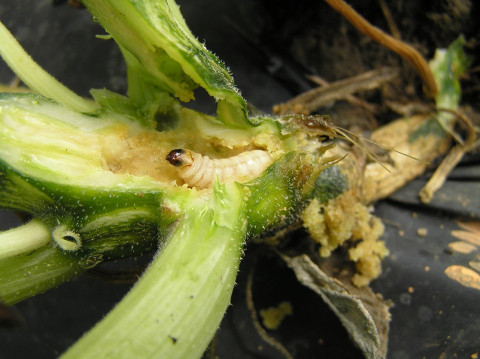
These pests, which look like fat white worms, feed on vine crops such as pumpkins, winter and summer squash, zucchini, and gourds.
They may also go after cucumbers and melons. Wilting is usually the first sign of an attack [1].
Adults are often mistaken for bees or wasps because of their movements and orange-and-black markings. They lay eggs at the base of plants.
After about a week, the larvae hatch out and cause damage by piercing into stems to feed.
How to Get Rid of Squash Vine Borers Naturally
1. Bacillus Thuringiensis (Bt)
BT is widely used as a biological pesticide in agriculture worldwide. It is a soil-dwelling bacterium that produces a protein that is toxic to certain insects and related pests.
Buy Bt for squash vine borers and spray it on the leaves and stems of your squash plants. You can also inject it directly into the plant’s vine.
Bacillus thuringiensis will kill squash vine borer eggs or larvae.
2. Row Covers
This is a popular method of protecting plants from many garden pests. Row covers of a special lightweight material are suspended over the growing crops, supported by hoops.
These coverings keep moths out, preventing them from laying eggs on the plants. However, the material will still allow light and air to reach your crops.
3. Yellow Sticky Traps
Yellow attracts the adult vine borer, so hanging yellow sticky traps near your crops will serve as bait. These will catch the adult moths and prevent them from laying eggs, thus breaking the cycle.
4. Parasitic Wasps
Some parasitic wasps feed on vine borer eggs. Additionally, parasitic wasps may lay eggs on or inside the larvae of these insects.
After hatching, the developing wasps parasitize the SVB larvae, devouring them as they feed and develop. Therefore, attract parasitic wasps to your garden to help control a vine borer infestation.
5. Trap Crop
Utilizing trap crops as companion plants can help draw these pests away from your main crop. One such crop is the blue Hubbard squash. These insects will flock to it instead of your main crop.
For that reason, plant it at the corners of your garden to help keep squash borers away [2]. The blue hubbard also repels squash bugs.
6. Remove by Hand
Picking off the squash vine borer larvae may be an unpleasant task, but it is an effective way to control vine borers organically.
You should also check thoroughly for eggs and remove them. They are tiny but orange-brown in color, and you will spot them at the bases of target plants.
7. Crop Rotation
Rotating crops is another way of controlling pests. Try not to plant squash in the same spot for two consecutive years.
If an alternating crop is planted, overwintering larvae will be unable to find suitable food in the following season.
8. Diatomaceous Earth (DE)
This is a naturally occurring substance composed of fossilized diatom remains.
Diatomaceous earth is very sharp, causing irritation for soft-bodied insects and related pests. This fine, powdery white substance will cut into squash worms, causing them to dehydrate and die.
Therefore, sprinkle DE around the base of the plants. You should also use it to dust the entire plant.
9. Aluminum Foil Wrap
Another squash vine borer control home remedy is an aluminum foil wrap. To protect the plant’s main stem, wrap it in foil.
This will prevent squash vine borer moths from laying their eggs on the stem.
10. Neem Oil
Neem oil is another remedy to prevent these pests from damaging your crops. It will kill vine borer larvae as they eat through the vine.
Therefore, make a homemade squash borer spray by combining 2 tablespoons of neem oil with a gallon of water. Use it to spray all the surfaces of your plants.
11. Beneficial Nematodes
There are harmful and beneficial nematodes. The helpful ones can be bought from specialist suppliers to apply to the soil.
Beneficial nematodes will seek out and devour the larval and pupal stages of SVB.
12. Mulch Plant Stems
The real problem with controlling the critters is their ability to get into plant stems, where spraying won’t reach them. Therefore, covering the main stem with mulch will help prevent squash vine borer eggs from being deposited there.
An adult female moth is capable of laying up to 150 eggs in a season. A good mulch will form a protective barrier for the plants’ stems.
13. Plant Late
Consider planting a crop later in the summer. Toward the end of August, female SVB moths will stop laying eggs.
Therefore, consider planting a second crop near the end of the laying period. The crop will likely mature after the pests stop laying eggs.
14. DIY Yellow Trap
These creatures are attracted to the color yellow. To make a homemade squash vine borer trap, fill a yellow container with soap and water.
The color will attract the adult moths, after which they will fall in and drown. Change and refill the soapy solution every few days.
15. Pest-Repelling Plants
These pests do not like the scent of certain plants. Plants that repel squash vine borers include mint, basil, onion, and parsley.
So, planting these in your garden will help keep vine borers away from your squash plants. Additionally, radishes repel the squash vine borer moth.
16. Spinosad
This is a natural insecticide that works against borers. You can also use it to control thrips, caterpillars, ants, and many other garden pests.
Spinosad is commercially available as a spray. Use it according to the instructions on the label.
Takeaway
Finding worms in squash can be very disheartening. However, adopting some of these home remedies and natural methods can be effective in addressing the problem.

 Sasha Campbell


Add comment