

 Sasha Campbell
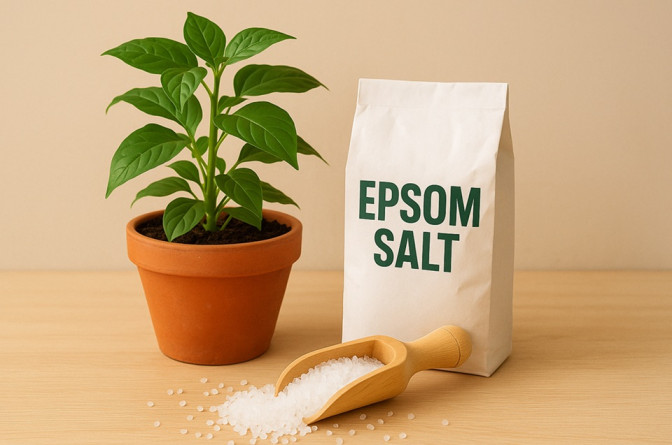
Epsom salt is a popular gardening product. Many gardeners use it on tomatoes, roses, peppers, and other plants.
Some people say it can make plants grow faster and produce more flowers and fruit. Others say it is not needed in most gardens.
So, what is the truth?
Epsom salt can help plants in some situations. But it is not a magic plant food. It should only be used when your plants or soil need the nutrients it provides.
In this guide, you will learn what Epsom salt is, when it may help plants, and why using too much can cause problems.
What Is Epsom Salt?
Epsom salt is a mineral compound called magnesium sulfate [1]. It provides two plant nutrients: magnesium and sulfur.
Magnesium helps plants make chlorophyll. Chlorophyll is the green pigment that helps plants use sunlight to make food through photosynthesis.
Sulfur is also important. Plants use it to make some proteins and other compounds needed for healthy growth [2].
However, Epsom salt is not a complete fertilizer. It does not contain nitrogen, phosphorus, or potassium. These are three major nutrients that plants often need in larger amounts.
For this reason, Epsom salt should not replace compost or a complete fertilizer. It is simply a source of magnesium and sulfur.
When Can Epsom Salt Help Plants?
Epsom salt may help when a plant has a confirmed magnesium or sulfur deficiency.
If the soil already contains enough of these nutrients, adding more Epsom salt is unlikely to improve plant growth.
This is why a soil test is the best way to find out if your soil needs more magnesium or sulfur. Yellow leaves can have many causes, including other nutrient problems, pests, diseases, poor drainage, and root damage.
Adding Epsom salt without knowing the cause may not solve the problem.
Can Epsom Salt Help With Sulfur Deficiency?
Sulfur helps plants make proteins and supports other important plant processes.
Sulfur deficiency can occur in some sandy soils, especially in areas where sulfur is easily washed out by heavy rain or irrigation. It may also occur in soils with very little organic matter.
A sulfur-deficient plant may have pale green or yellow leaves [3]. Unlike nitrogen, sulfur does not move easily from older leaves to new growth. Because of this, newer leaves may show symptoms first.
However, sulfur deficiency can look like other nutrient problems. A soil test or plant test may be needed to find the real problem.
If testing shows that sulfur is low, a suitable fertilizer can supply it. Epsom salt also contains sulfur, but it should only be used if the plant or soil needs the magnesium and sulfur it provides.
Signs of Magnesium Deficiency
A common sign of magnesium deficiency is yellowing between the veins of older leaves. The veins may stay green. This is called interveinal chlorosis.
Other possible signs include slow growth and weak-looking plants.
However, these symptoms can also be caused by other problems. For example, yellow leaves may result from poor drainage, root problems, pests, disease, or another nutrient deficiency.
Because of this, it is best not to assume that yellow leaves mean a plant needs Epsom salt.
A soil test can help confirm whether magnesium is actually low.
How to Use Epsom Salt in the Garden
If a soil test shows that your soil is low in magnesium, Epsom salt may be one way to supply more magnesium. However, the best product depends on the soil’s pH and other conditions.
It can be applied to the soil or used as a diluted foliar spray. However, the correct amount depends on the plant, soil, and type of problem.
Always follow the product label when one is available.
Example Epsom Salt Soil Drench Recipe
If a soil test shows that a plant needs extra magnesium, a diluted Epsom salt solution may be one way to supply it.
As one example, some gardening recommendations use 1 tablespoon of plain Epsom salt mixed with 1 gallon (3.8 L) of water. Apply the solution to the soil around the plant’s root zone.
However, this is only an example rate. The correct amount may vary depending on the plant, soil, and severity of the deficiency. Always follow the product label or advice from a trusted gardening expert when available.
Do not use this solution on a regular schedule unless there is a confirmed need for extra magnesium. If your soil already contains enough magnesium, adding more is unlikely to improve plant growth and may contribute to nutrient imbalances.
Example Epsom Salt Foliar Spray Recipe
Epsom salt can sometimes be used as a foliar spray to provide magnesium to a plant with a confirmed deficiency.
As one example, some gardening recommendations use 1 tablespoon of plain Epsom salt dissolved in 1 gallon (3.8 L) of water. Place the mixture in a clean spray bottle and lightly mist the leaves.
The correct concentration can vary between plants. A solution that is too strong may damage the leaves. For this reason, test the spray on a small number of leaves first and watch for signs of damage.
Apply the spray during the cooler part of the day, such as early morning or evening. Avoid spraying in hot, strong sunlight.
A foliar spray may provide short-term help when a plant has a magnesium deficiency. However, it does not replace good soil care and may not solve the problem if the deficiency has another cause.
Use foliar sprays only when there is a clear reason to provide extra magnesium. If a product label or local gardening recommendation gives a different rate for your specific plant, follow that recommendation instead.
Epsom Salt for Tomatoes and Peppers
Tomatoes and peppers are often mentioned in gardening advice about Epsom salt. However, these plants do not automatically need Epsom salt just because they are heavy feeders.
A heavy-feeding plant needs enough nutrients for healthy growth. Epsom salt provides only magnesium and sulfur. It does not provide all the nutrients that tomatoes and peppers need.
If a soil test shows a magnesium deficiency, Epsom salt may help supply magnesium. If magnesium levels are already adequate, adding more is unlikely to improve growth or fruit production.
Epsom Salt for Roses and Flowers
Some gardeners use Epsom salt on roses and other flowering plants.
Magnesium is important for healthy plant growth. However, Epsom salt is not a guaranteed way to produce more flowers.
If a rose has yellow leaves between the veins, magnesium deficiency is one possible cause. But other problems can cause similar symptoms.
A soil test can help determine whether adding magnesium is needed.
Epsom Salt and Fruit Trees
Magnesium is an important nutrient for fruit trees.
However, fruit trees should not be given Epsom salt simply because a gardener wants more fruit or sweeter fruit.
If a tree has a confirmed magnesium deficiency, a suitable magnesium fertilizer may help correct the problem.
The best way to manage fruit trees is to focus on healthy soil, proper watering, good growing conditions, and a balanced fertilization plan when needed.
Does Epsom Salt Cure Blossom End Rot?
No. Epsom salt does not cure blossom-end rot.
Blossom-end rot happens when the developing fruit does not receive enough calcium at the right time. This does not always mean that the soil lacks calcium. Uneven watering, root damage, and other stresses can interfere with the movement of calcium into the fruit.
Adding Epsom salt is not a reliable treatment because Epsom salt supplies magnesium and sulfur, not calcium.
In fact, adding extra magnesium when it is not needed can contribute to nutrient imbalance.
Does Epsom Salt Make Tomatoes Sweeter?
There is no good reason to use Epsom salt as a general treatment to make tomatoes sweeter.
If a plant has a magnesium deficiency, correcting that deficiency may help the plant grow better. However, this does not mean that Epsom salt directly makes healthy tomatoes sweeter.
Fruit flavor depends on many factors, including the plant variety, growing conditions, ripeness, and the balance of water and nutrients.
Can Epsom Salt Help Lawns?
Magnesium is involved in chlorophyll production, so it is sometimes promoted as a way to make lawns greener. However, a lawn does not need extra magnesium unless the soil is deficient.
If a lawn is already receiving enough magnesium, applying Epsom salt is unlikely to make it greener.
A soil test can help show whether magnesium is low. Proper mowing, watering, soil care, and the right fertilizer are usually more important for maintaining a healthy lawn.
Does Epsom Salt Control Pests?
Epsom salt is sometimes promoted as a way to repel slugs and other garden pests. However, there is no strong evidence that Epsom salt provides reliable, long-term pest control in the garden.
It should not be treated as a proven insecticide or slug control product.
If you have a pest problem, it is better to identify the pest first and use a control method that is known to work against that particular pest.
Does Epsom Salt Kill Weeds?
Epsom salt is sometimes included in homemade vinegar weed-killer recipes. However, Epsom salt is not a reliable weed killer.
Vinegar may burn the leaves of some weeds, but household vinegar may not kill weeds with deep or established roots.
Do Not Use Epsom Salt Automatically
Many popular gardening recipes recommend using Epsom salt on tomatoes, peppers, roses, and other plants on a fixed schedule. However, this is not necessary for every garden.
If your soil already contains enough magnesium and sulfur, adding more will not act as a general plant booster. For the best results, test your soil when possible and use Epsom salt only when there is a clear need.
Which Plants May Benefit From Epsom Salt?
Any plant can have too little magnesium if the soil does not contain enough of it.
Some plants often mentioned in connection with Epsom salt include tomatoes, peppers, roses, cucumbers, squash, and container plants.
However, the plant type alone does not tell you whether Epsom salt is needed. The soil is more important.
A tomato plant growing in soil with low magnesium may benefit from added magnesium. Another tomato plant growing in soil with enough magnesium may not benefit at all.
Epsom Salt for Container Plants
Plants grown in containers can sometimes develop nutrient problems because they have a limited amount of growing medium.
Frequent watering can also cause some nutrients to move out of the container over time.
Still, Epsom salt should not be used automatically.
A complete fertilizer made for container plants is usually more useful for supplying the wide range of nutrients plants need. Epsom salt may be useful only when a magnesium or sulfur deficiency is present.
Can Epsom Salt Damage Plants?
Yes, using too much can cause problems.
Epsom salt adds magnesium and sulfur to the soil. If you add more than the soil needs, the extra nutrients do not simply disappear.
Too much magnesium can interfere with the balance of other nutrients, including calcium and potassium. This can make it harder for plants to take up some nutrients.
The risk can be greater in containers and small garden beds if Epsom salt is used repeatedly, especially when drainage is poor. Nutrients and soluble salts can build up in the growing medium.
This is why more Epsom salt is not better.
Where Can You Buy Epsom Salt?
Epsom salt is widely available at pharmacies, supermarkets, garden centers, and online stores.
If you use Epsom salt in the garden, choose a plain product that contains only magnesium sulfate. Avoid bath products that contain fragrances, oils, dyes, or other added ingredients.
Always read the product label before using Epsom salt in the garden.
The Best Way to Grow Healthy Plants
Healthy soil is more important than any single gardening product.
Adding compost and other organic matter can help improve soil structure. A soil test can show which nutrients may be low or too high.
Plants also need the right amount of sunlight, water, and space to grow well.
Epsom salt can be useful when a plant truly needs extra magnesium or sulfur. But it is not a general plant booster.
If your plants are healthy and growing well, there is usually no reason to add Epsom salt.
Frequently Asked Questions
Can You Put Epsom Salt Directly on Soil?
Yes. However, it is important to use the correct amount for the plant and the soil.
Dissolving it in water can help spread the product more evenly around the root zone.
A soil test can help you decide whether adding magnesium is needed in the first place.
Does Epsom Salt Lower Soil pH?
No. Epsom salt adds magnesium and sulfur, but it is not a reliable product for lowering soil pH.
If your soil is too alkaline, use a soil test to find the best way to manage the pH.
How Often Should You Apply Epsom Salt?
There is no single schedule that is right for every plant.
Epsom salt should be used only when there is a clear need for extra magnesium or sulfur.
Routine applications are usually unnecessary when the soil already contains enough of these nutrients.
Does Epsom Salt Make Tomatoes Sweeter?
No reliable evidence shows that Epsom salt directly makes healthy tomatoes sweeter.
It may help a plant with a magnesium deficiency recover, but it is not a tomato flavor booster.
Is Epsom Salt Safe for All Plants?
Epsom salt is not automatically harmful to plants, but it should not be used without a reason.
Using too much can lead to nutrient imbalances.
Always consider the condition of the soil and follow the product label when available.
Takeaway
Epsom salt is best viewed as a source of magnesium and sulfur.
It may help plants when one or both of these nutrients are lacking. But it is not a complete fertilizer, a general growth booster, a reliable pest control product, or a cure for blossom-end rot.
The best approach is to test the soil when possible and find out what your plants actually need.
If your soil is healthy and your plants are growing well, you probably do not need Epsom salt.
In gardening, the best results usually come from healthy soil, proper watering, good growing conditions, and using the right product for the right problem.




Add comment