

 Andre Campbell
Blister beetles produce a chemical called cantharidin. This chemical is toxic to humans and animals and may cause dehydration, blisters, and even renal failure if swallowed.
If eaten by an animal (even one as big as a horse), it only takes around 25 blister beetles to kill that animal [1]. With this in mind, it’s imperative that you correctly identify these pests and get rid of them as soon as possible.
Identification
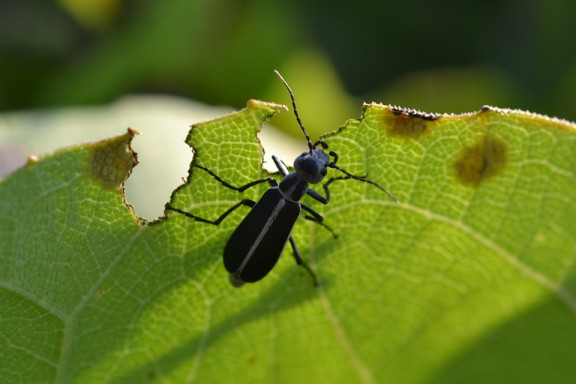
Adult blister beetles are 0.1 to 0.8 inches long [2]. They have broad heads, long legs, and thin, beaded antennae.
They also have flexible, soft wing covers. These beetles travel in groups. When disturbed, they drop to the ground and hide.
How to Get Rid of Blister Beetles Naturally
Below are some home remedies and natural solutions to get rid of these harmful insects in your garden.
1. Handpick
One inexpensive way to control blister beetles is to pick them off. However, it’s best to wear gloves.
Also, if you don’t grab it before it sees you, the beetle may fall beneath the plants it’s feeding on or get lost in the hay.
So, pick up the beetle. But don’t squish it. Put it in a container or bucket of soapy water.
If you squish it, you could end up with cantharidin all over your gloves, which could then transfer to your bare skin.
2. Diatomaceous Earth (DE)
Apply diatomaceous earth at the base of the host plants, around stones, and anywhere else you might think these beetles will lay their eggs.
The sharp edges of this product will cut the underside of the beetle, later killing it.
3. Oyster Lime Shell (OLS)
OLS is another natural powder that helps control blister beetles. It won’t kill them, as it is more of a repellent, but you can use it as an excellent barrier in pots and raised beds.
Oyster lime also enriches soil quality and balances soil pH levels.
4. Spinosad
Spinosad is an excellent blister beetle treatment because it kills them in one to two days.
Though many consider it a chemical rather than a natural way to get rid of bad bugs in your garden, we included it because that is not the case.
That’s because spinosad is derived from the fermentation of a soil bacterium, making it perfectly natural. Moreover, it’s OMRI-listed.
Apply this blister beetle treatment to the critters. The product must make direct contact with the bugs to achieve effective results.
5. Birds
Having birds around is one of the best ways to get rid of blister beetles organically. Many birds love beetles. They’ll happily pick them off your plants for you.
Attracting birds is as simple as providing water and an initial food source until they discover these pests. Certain plants and flowers, like sunflowers and coneflowers, may attract birds.
6. Row Covers
Row covers range anywhere from simple screens on frames to rolls of plastic sheeting stretched out over rows in the garden.
Install your row covers right after planting but before the adult beetles emerge. However, be sure to remove them when it’s time for pollination.
7. Weed Control
Blister beetles will flock to weeds during bloom. They like ironweed, pigweed, and ragweed.
Therefore, eliminate weeds in and around your vegetable garden to help keep blister beetles away.
However, some gardeners will keep pigweed (a trap crop) around in the hopes that the beetles will feed on it rather than on their crops.
8. Repel Grasshoppers
Blister beetle larvae eat grasshopper egg pods. Therefore, eliminating grasshoppers is highly effective in preventing infestations.
If you see a lot of grasshoppers in your garden or around the house, you may also see more blister beetles around. A little reading will tell you the best ways to get rid of grasshoppers.
9. Bug-Buster-O
Bug Buster-O is an excellent natural insecticide if you want the critters to go away without having to whip up DIY recipes. Spray it directly on the blister bugs, but be careful not to soak the plant or the soil.
Bug Buster-O can be bought commercially. You can also use it to control other pests, such as asparagus beetles, bean beetles, and elm leaf beetles.
10. Neem Oil
Neem oil is also an excellent home remedy for beetle control. This all-natural oil coats the adult blister beetle’s body and disrupts its life cycle.
Mix it in a ratio of 2 teaspoons to one gallon of water with a liquid soap like Castile. Shake well, then spray directly onto the beetles.
Takeaway
If you find blister beetles in your garden or hay, this article lists some of the best natural ways to repel and kill them.
Some of these methods are effective when used alone. Others, used with other remedies, have done quite a bit to keep these beetles out of the garden.
It all depends on how much work you are willing to do before, during, and after a noticeable infestation.

 Sasha Campbell



Hi Andre Campbell
How can I get rid of Caterpillars from my veggies
I have tried Garlic Cloves in tab water and sprayed in on them
They keep on coming back to my veggies
What should I do ?
They are still bugging me
Please please tell me what I should do
Please give me a answer 🤬😤
I am waiting for your answer back #
Hi Sammy,
Read these two articles:
https://drecampbell.com/natural-ways-get-rid-caterpillars-plants/
https://drecampbell.com/homemade-caterpillar-killer-sprays/
That’s all we have on the topic.
Regards,
Sasha
Thank you very very much for answering my message Sasha that is very helpful thank you