

 Sasha Campbell
If you’re reading this, you’ve likely encountered onion thrips. These pests feed on the leaves of many alliums, including onions, shallots, leeks, and chives.
The damage they cause can be significant. While chemical treatments are available, many gardeners prefer a natural approach to get rid of these pesky pests.
In this article, we will discuss some natural methods for controlling onion thrips in your garden.
Damage Symptoms
One of the first signs that you have onion thrips (Thrips tabaci) is witnessing the damage they cause. They feed on many plants, but onions themselves are a favorite.
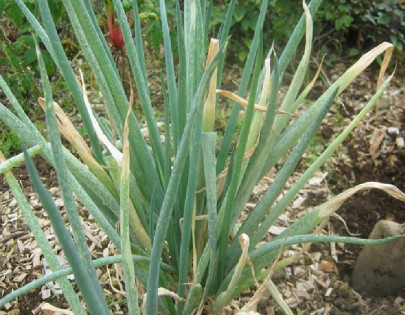
Onion leaves affected by onion thrips will discolor, forming white patches, and curl and twist [1]. Additionally, if you look closely, you will see silvery streaking.
The onion bulbs themselves can also be damaged by onion thrips. You might have undersized bulbs.
Crops Affected by Onion Thrips
These tiny insects are attracted to a range of plants. These plants include chives, alfalfa, green onions (scallions), shallots, garlic, and leeks [2]. As mentioned, they can cause serious damage to the crops.
It’s important to check your garden regularly for signs of an infestation. This is especially crucial in hot, dry weather. By doing so, you can take action immediately to prevent further damage.
Be sure to inspect all plants in the onion family and those listed above for any signs of silver lines and white patches on leaves.
How to Get Rid of Onion Thrips Naturally
Let’s dive into some of the best natural methods to keep your crops safe from thrips.
1. Sprinkler Irrigation
Overhead watering or sprinkler irrigation is a great way to keep these onion pests at bay. It will wash them off, reducing the thrips population buildup.
Farmers who use overhead irrigation in their fields have fewer thrips problems.
2. Natural Predators
There are a few natural enemies that can help control onion thrips.
Examples are big-eyed bugs, lacewing larvae, parasitic wasps, minute pirate bugs, ladybugs, and predatory mites. These insects help manage pest populations by preying on harmful species.
Now, if you’re going this route, you’ll need to find a way to attract and retain these natural predators.
With a little research and commitment, this biological control of onion thrips is a great way to protect your plants.
3. Straw Mulch
Straw mulch has proven to help reduce thrips populations in onion beds [3]. Moreover, it is easy to install and helps retain soil moisture, keeping your onion crop healthy.
It’s also great for the environment. Using straw mulch helps prevent soil erosion. It also creates a healthy space for beneficial microorganisms to break down organic matter.
4. Companion Planting
Planting marigolds near onions is said to help repel onion thrips.
Planting onions with fennel, potatoes, carrots, tomatoes, cucurbits, or chrysanthemums can help deter thrips. These plants can also act as trap crops to lure thrips away.
Plant these in between rows of onions or along the borders of your garden for extra protection.
5. Practice Good Field Sanitation
You can fight onion thrips with the simplest and least costly method of all: good field sanitation.
Regularly checking and removing volunteer onion plants, crop debris, and excess plant material can significantly reduce the number of onion thrips.
6. Soapy Water
One effective home remedy that worked for us is soapy water. Since it works so well in getting rid of bugs and other insect pests, we decided to give it a try.
All we did was mix 2 tablespoons of liquid soap with a gallon of water. We then poured it into a spray bottle and sprayed a small patch of our scallions that were affected by thrips tabaci.
The next day, we turned on the overhead sprinklers to wash off the soapy residue.
To our surprise, the leaves had a pretty green color and were clean as a whistle. They started straightening up, too—the curly leaves were almost completely gone.
Best of all, this homemade onion thrips control spray is cheap, so everyone can give it a try. Just be sure to use organic liquid soap if you have an organic garden.
7. Avoid Excessive Amounts of Nitrogen Fertilizer
You may not know it, but too much nitrogen fertilizer can actually encourage onion thrips infestations. So, it’s best to try to avoid excessive amounts.
8. Avoid Infected Transplants
The last thing you want to do is introduce transplants already infected with these pests into your garden. That’s why it’s important to check any transplants you buy for signs of infestation.
9. Sticky Traps
You can also trap adult thrips using yellow or blue sticky cards placed near plants that are likely to be affected.
10. Bonide Captain Jack’s Orchard Spray
If you’re looking for a natural pesticide for onion thrips, try Bonide Captain Jack’s Orchard Spray.
This product is a natural fungicide and pesticide with sulfur and pyrethrin as its active ingredients.
This spray kills thrips. It’s also effective against aphids, leaf miners, mites, spittlebugs, whiteflies, and other pests.
Takeaway
To control onion thrips and stop re-infestations, use a mix of cultural, biological, and mechanical methods.
Keeping a sharp eye out for these pests can help reduce their numbers. Regularly monitoring your crop will help you spot problems before they become serious.
The natural remedies outlined above will help keep your garden free of onion thrips and improve your harvest.



Add comment