

 Andre Campbell
You’re in the market for natural fungicides for your plants, but you don’t know where to start.
We get it. The options can be daunting; knowing which ones are worth your money is difficult.
But don’t worry. Below, we’ll share tips for making some homemade plant disease sprays, along with several organic fungicides you can buy.
This list of natural fungicides for plants can help you manage common fungal diseases without relying on harsh chemicals.
What Is a Natural Fungicide?
A natural fungicide is a substance derived from natural sources. It helps prevent or control fungal diseases that affect plants.
These fungicides can come from plants, minerals, beneficial microorganisms, or common household ingredients.
Many gardeners choose natural fungicides because some may have a lower environmental impact than certain synthetic products. However, natural does not always mean harmless. Always follow the product label and use homemade sprays carefully.
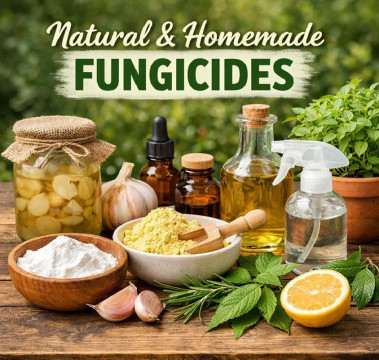
Natural and Homemade Plant Fungicides
1. Chamomile Tea
Some gardeners use chamomile tea to help reduce fungal problems in young seedlings, including damping-off. However, results may vary.
To make a chamomile tea spray, steep 2 chamomile tea bags in 2 cups of hot water, then let it cool completely.
Pour the tea into a spray bottle and lightly mist the seedlings and surrounding soil. Results may vary, so test it on a small area first.
2. Horticultural Oil
Horticultural oils can help manage some fungal diseases, especially certain powdery mildews. They may also help prevent disease from spreading on plant surfaces [1].
Always check the product label before using horticultural oil on a plant.
3. Potassium Bicarbonate
Potassium bicarbonate is a natural mineral that can help control several fungal diseases on plants. It is especially useful against powdery mildew.
Unlike baking soda, potassium bicarbonate does not add as much sodium to the soil. It works by making the surface of plant leaves less suitable for some fungi.
You can buy potassium bicarbonate as a ready-made garden fungicide. Always follow the product label for mixing and application instructions.
Before spraying the entire plant, test the product on a small area first. This helps you check for possible leaf damage.
4. Organic Milk
Milk can sometimes help manage powdery mildew and other leaf diseases on certain plants. Some research has found that milk sprays may help control powdery mildew on zucchini [2].
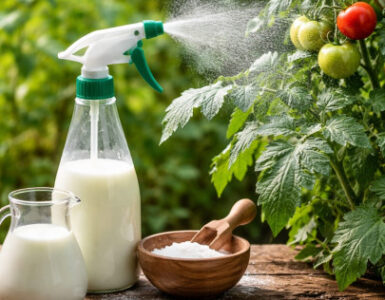
Mix one cup of milk with ten cups of water. Pour this homemade fungus spray into a spray bottle and spray the leaves until they are lightly covered, but avoid excessive runoff.
5. Garlic Spray
Some gardeners use garlic sprays to help manage certain fungal problems. However, results can vary, and garlic sprays may damage sensitive plants.
You can make a simple garlic spray with five cloves of garlic and two cups of water.
Blend and strain to remove chunks, then pour the liquid into a spray bottle. Add a few drops of liquid soap to the solution and shake it up.
Finally, use this DIY spray right away. Test the spray on a small part of the plant first and stop using it if you notice leaf damage.
6. Compost Tea
Some gardeners use compost tea as a soil drench or foliar spray. However, homemade compost teas can contain unwanted microorganisms, especially if they are made with manure.
Use well-finished compost, avoid spraying edible plant parts close to harvest, and follow local food-safety guidance.
To make compost tea, soak one part well-finished compost in five parts non-chlorinated water for 24 to 48 hours. Strain the liquid and use it as a foliar spray or soil drench.
If you choose to use compost tea, follow a trusted recipe and use it according to the guidance for the specific preparation.
7. Lime Sulfur
Lime sulfur is a natural fungicide made from sulfur and lime. It can help control certain fungal diseases on plants.
Gardeners may use it against diseases such as powdery mildew, rust, and some other fungal problems. It can also help manage certain pests, depending on the product.
Lime sulfur is a strong product and can burn plants if used incorrectly. Always follow the product label carefully.
Avoid using it during very hot weather. Also, do not use lime sulfur together with oil sprays or too close to an oil application unless the product label says it is safe.
8. Trichoderma
Trichoderma is a beneficial fungus that can help protect plants from some harmful fungi [3].
These helpful microorganisms live around plant roots and can compete with disease-causing fungi. Some products containing Trichoderma are used to help protect seeds, roots, and soil.
Trichoderma products come in different forms, so always follow the instructions on the product label. They are not a cure for every fungal disease, but they can be useful as part of a natural plant-care plan.
9. Horseradish
Some traditional gardening recipes use horseradish root to make a homemade spray for fungal diseases. However, evidence for its effectiveness in home gardens is limited.
Blend 1 cup of horseradish root with 2 cups of water and let it sit for 24 hours.
Afterward, strain it and add the liquid to two quarts of water. The mixture is now ready to test on plants.
Test the spray on a small part of the plant first, as homemade plant sprays can sometimes cause leaf damage.
10. Neem Oil
Neem oil has antifungal properties. It can be useful in organic gardening, but it can still harm plants if used incorrectly.
When using neem oil as a fungicide, follow the product label for the correct amount. Many neem oil products also require an emulsifier, such as insecticidal soap, to help the oil mix with water.
You can also buy the concentrate online or at your local garden store. Some neem oil products are labeled for use against certain fungal diseases, including powdery mildew.
Always check the label to see which diseases and plants are covered.
Some neem oil products are labeled for use against fungal diseases on certain fruit trees. However, avoid spraying during hot weather or in strong direct sunlight.
11. Bacillus subtilis
Bacillus subtilis is a beneficial bacterium used in some natural and biological fungicides.
It can help protect plants from certain fungal diseases by competing with disease-causing microorganisms and making it harder for some harmful fungi to grow.
Some products containing Bacillus subtilis are labeled for use against diseases such as powdery mildew, gray mold, and certain leaf spots.
These products come in different forms, so always follow the instructions on the product label. Test a new product on a small part of the plant first to check for any damage.
12. Baking Soda Spray
Making a baking soda spray is another home remedy to ward off fungus. You will need only baking soda, water, and a spray bottle.
Mix 1 teaspoon of baking soda with 1 quart of water, then pour it into your spray bottle. Add a few drops of a mild liquid soap or a product made for use on plants.
When you’re ready to use it, spray it onto your plants’ leaves. It’s best to do this when the sun isn’t shining directly on the plants.
Use this DIY fungicide on roses, hollyhocks, peonies, and vegetables.
Do not use more baking soda than recommended. Too much sodium can damage plants and build up in the soil.
13. Cinnamon Oil
Cinnamon oil has antifungal properties, but concentrated essential oils can burn plant leaves. Because of this, use only a properly formulated product according to its label.
Always test any new spray on a small part of the plant first.
14. BONIDE Liquid Copper Fungicide
There are many store-bought fungicides approved for use in organic gardening systems. Bonide Liquid Copper Fungicide is one such product.
It offers protection against several plant diseases, including powdery mildew, apple scab, black spot, and anthracnose. The diseases covered can vary by product formulation and location, so always check the current product label before use.
Copper fungicides often work best when used early, before a disease becomes severe. However, even these products must be used carefully.
15. Fungastop L&G
Fungastop L&G is a citric-acid-based product that is listed for use against certain plant diseases. Always check the current product label for approved plants, diseases, and application instructions.
16. Sulfur
Sulfur is one of the oldest and most widely used organic fungicides.
It is commonly used against diseases such as powdery mildew and some rust diseases. Its effectiveness depends on the disease and the product label.
Do not use sulfur close to oil sprays unless the product label says it is safe. Some combinations can damage plants.
Sulfur is available as a dust or spray at most garden centers.
However, always follow the product label directions. Using too much can harm plants, especially in hot weather.
Preventing Fungal Diseases Naturally
The best way to fight fungal diseases is to prevent them from developing in the first place.
Water plants at the base when possible, improve air circulation, and avoid overcrowding. Remove badly infected leaves and dispose of them away from healthy plants.
Healthy plants are often more resistant to fungal infections.
FAQ
What is the most effective natural fungicide?
There is no single best natural fungicide for every disease. Sulfur, copper products, neem oil, baking soda, and other options may help with certain diseases.
The best choice depends on the plant and the fungus causing the problem.
Can I make a fungicide at home?
Yes. Popular homemade options include baking soda sprays, milk sprays, garlic sprays, and chamomile tea.
What helps control fungus on plants naturally?
Natural products such as sulfur, copper fungicides, neem oil, and baking soda may help control certain fungal diseases. However, they do not work against every fungus, and badly damaged leaves may not recover.
Is neem oil a fungicide?
Neem oil has antifungal properties, and some neem products are labeled for managing certain fungal diseases. Always follow the product label.
Can baking soda kill fungus on plants?
Baking soda can help slow the spread of certain fungal diseases on leaves, especially powdery mildew. However, it does not cure severe infections, and it may damage plants if used too heavily.
Is sulfur safe for organic gardening?
Yes. Sulfur is approved for use in many organic gardening systems.
Sulfur has been used to manage plant diseases for a very long time.
Can natural fungicides harm plants?
Yes. Even natural products can damage plants if used incorrectly or in excessive amounts.
Always test a new spray on a small area first and follow the recommended application rates.
Takeaway
These remedies may help you manage some common fungal diseases without relying on certain synthetic products. However, prevention is still important, and the right treatment depends on the plant and the disease.
Choose a treatment that is suitable for your plant and disease. Always follow the product label or test a homemade spray on a small area first.

 Sasha Campbell



Add comment