

 Sasha Campbell
Greater burdock (Arctium lappa) is a large plant that is often treated as a weed. However, its roots and young stalks can be eaten when they are correctly identified and properly prepared.
The plant is best known for its huge leaves and round, prickly burs. These burs easily stick to clothes and animal fur. In fact, burdock burs helped inspire the development of hook-and-loop fasteners.
For gardeners interested in edible weeds, greater burdock is worth learning about. Its long taproot is eaten as a vegetable in several parts of the world.
However, burdock must be managed carefully. It can spread easily, and its mature burs may harm animals. Correct identification is also very important before eating any wild plant.
What Is Greater Burdock?
Greater burdock belongs to the daisy family, Asteraceae. Its scientific name is Arctium lappa.
It is a biennial plant. This means its normal life cycle lasts for two years.
During its first year, burdock mainly produces leaves and develops a thick taproot. During its second year, it sends up a tall flowering stalk. Flowers and seeds follow.
A mature plant can become quite large. In good conditions, flowering plants may grow several feet tall.
Where Does Greater Burdock Grow?
Greater burdock is native to parts of Europe and Asia. It has also become established in other regions, including parts of North America.
It commonly grows in disturbed ground.
You may see it along field edges, roadsides, paths, old gardens, vacant areas, and other places where the soil has been disturbed.
Burdock generally grows best in fertile soil with enough moisture. It can grow in full sun and tolerate some shade.
How to Identify Greater Burdock
Greater burdock is easiest to identify by looking at several parts of the plant together.
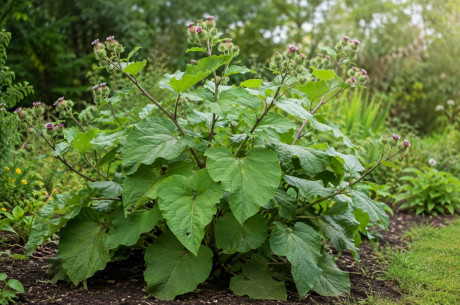
During its first year, the plant forms a circle of leaves close to the ground. This is called a rosette. The leaves are very large, broad, and shaped somewhat like a heart [1].
The top of each leaf is green. The underside is much paler and covered with soft, woolly hairs. The leaf stalks are usually thick and have a groove running along the upper side.
During the second year, the plant grows a tall, branched flower stalk. Small purple flowers appear in round heads. These later become prickly burs covered with tiny hooks.
Do not identify burdock by its large leaves alone. Young burdock can look similar to other broad-leaved plants. Check the leaf shape, pale hairy undersides, growth pattern, flower heads, and burs before deciding what the plant is.
Greater Burdock vs. Common Burdock
Greater burdock can be confused with common burdock, also called lesser burdock (Arctium minus).
Both plants have large leaves, purple flowers, deep roots, and hooked burs. However, greater burdock usually grows larger. Its flower heads are also generally larger and often grow on longer stalks in loose, somewhat flat-topped groups.
Common burdock usually has smaller flower heads. Its flower heads may grow on very short stalks or sit close to the branches.
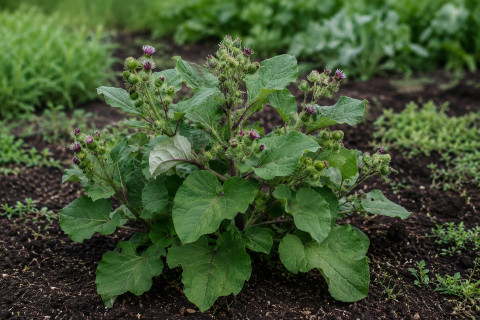
Picture of common burdock, also called lesser burdock (Arctium minus).
These differences can be hard for a beginner to see. Do not identify the plant by its height alone. Compare the leaves, flower heads, stalks, burs, and overall growth pattern. A local field guide or plant expert can help confirm the species.
Is Greater Burdock Edible?
Yes. Greater burdock has a long history as an edible plant.
The root is its best-known edible part. It is particularly valued as a vegetable in Japan, where burdock root is commonly known as gobo.
Young leaf stalks and tender flowering stems can also be eaten.
The large mature leaves are generally not the preferred part. They become coarse and can taste quite bitter.
What Does Burdock Root Taste Like?
Burdock root has an earthy flavor. Some people describe it as mildly sweet, nutty, or similar to other root vegetables.
Its texture can remain pleasantly firm after cooking.
Because its flavor is fairly mild, burdock root works well with stronger seasonings and other vegetables.
Nutrients in Greater Burdock Root
Burdock root contains carbohydrates and dietary fiber. It also provides a small amount of protein and very little fat.
The root contains minerals such as potassium, magnesium, phosphorus, calcium, and manganese. It also provides small amounts of vitamin B6 and vitamin C.
Burdock should not be described as a major source of every nutrient on this list. The amount of each nutrient may be modest. Nutrient levels can also change with the plant’s age, growing conditions, serving size, and cooking method.
Source of Fiber
Burdock root contains inulin, a type of soluble fiber that is found naturally in many plants [2].
Inulin is also present in foods such as chicory root, Jerusalem artichokes, garlic, and onions.
Some people may develop gas, bloating, or stomach discomfort after eating a large amount of inulin-rich food. If you have never eaten burdock root before, begin with a small serving to see how your body responds.
How Greater Burdock Grows
Greater burdock puts much of its energy into its root during its first year.
This root can become long and thick. It helps the plant store energy for its second year.
The plant then produces a tall flowering stem. After flowering and producing seeds, the plant completes its life cycle.
Why the Taproot Matters
Burdock develops a deep taproot when soil conditions allow it.
The root can reach well below the soil surface, which helps the plant find moisture.
Deep-rooted plants can also create channels through the soil as their roots grow and eventually decompose.
However, burdock should not be thought of as a quick fix for heavily compacted soil. Adding organic matter and avoiding unnecessary soil traffic are more dependable ways to improve soil structure.
Garden Benefits of Greater Burdock
Greater burdock has some value in a carefully managed garden.
Its purple flowers produce nectar and pollen for bees and other visiting insects. Its large leaves may also provide shade and cover close to the soil.
However, burdock is not suitable for every garden. Its large leaves can block sunlight from smaller plants. It may also compete with nearby plants for water, nutrients, and space.
Burdock can spread when its hooked burs carry seeds to new places. If you keep it in your garden, remove the flower heads before the burs and seeds mature.
Burdock and Wildlife
Burdock flowers provide nectar and pollen for bees and other visiting insects.
However, mature burs can harm wildlife. They may become tangled in animals’ fur. Small birds and bats have also been reported trapped in groups of burs [3].
The tiny bristles inside mature seed heads may irritate the eyes, skin, or breathing passages of people and animals. Wear gloves when handling old, dry seed heads and avoid shaking them near your face.
If you grow burdock for food or flowers, cut off the flower heads before the burs and seeds fully mature.
Growing Greater Burdock for Food
You do not have to forage for burdock. You can also grow it from seed.
Before planting it, check whether burdock is listed as an invasive or troublesome weed in your area [4]. Avoid growing it where it could spread into farms, pastures, parks, or natural areas.
Choose a sunny or partly shaded area with loose, deep soil. Remove stones and break up hard clumps before planting. Soft soil allows the long roots to grow more evenly and makes harvesting easier.
Sow the seeds directly where you want the plants to grow. Cover them lightly with soil and keep the ground evenly moist while they sprout. Thin crowded seedlings so each plant has room to develop.
Water during long dry periods, but do not leave the soil wet and soggy. Harvest the roots during the first year, before the plants send up tall flower stalks.
Never allow unwanted plants to produce mature burs and seeds.
Managing Burdock in the Garden
Think carefully before letting burdock grow wherever it wants. Its large size can shade smaller plants, while its burs can become a nuisance.
Cutting off flower heads before seeds mature helps prevent unwanted spreading.
If you want the edible roots, harvesting first-year plants gives you food while also stopping those plants from producing seed.
Growing in Containers
You can grow burdock in a container, but the container needs to be deep. Its long taproot needs plenty of room.
A deep container filled with loose growing mix can also make harvesting easier because you do not have to dig through hard garden soil.
Choose a container with good drainage.
When to Harvest Burdock Root
Harvest the root during the plant’s first year, before it produces its tall flowering stalk. At this stage, the root is usually more tender.
Once the plant enters its second year and puts energy into flowering, the root can become tougher and less desirable for eating.
How to Harvest the Root
Harvesting burdock can take some patience.
Its taproot may extend deeply into the ground. Pulling hard on the leaves will often break the root instead of removing it.
Loosen the soil alongside the root with a garden fork or spade. Work downward carefully before lifting it.
Loose garden soil makes this job much easier.
Cleaning Burdock Root
Freshly harvested roots usually hold quite a bit of soil.
Rinse them thoroughly under clean running water and scrub away dirt with a vegetable brush.
The skin is edible when the root is young and properly cleaned, so heavy peeling is not always necessary.
Trim away damaged or tough sections before cooking.
How to Eat Greater Burdock
Burdock root is normally cooked rather than eaten raw in large amounts.
You can slice it thinly, shred it, simmer it, stir-fry it, roast it, or add it to soups and stews.
One well-known Japanese dish is kinpira gobo, which uses thin strips of burdock root, often with carrot and seasonings.
You can also cook burdock alongside other root vegetables.
Can You Eat Burdock Stems?
Young leaf stalks and tender flower stalks can be eaten. Harvest them before they become tough and stringy.
Remove the leaves and peel away the fibrous outer layer. Cut the tender inner part into smaller pieces and cook it by boiling, steaming, or sautéing.
Some stalks may taste bitter. Briefly boil them and change the water to help reduce the bitterness.
Do not collect old stalks from mature plants. They are usually tough, woody, and unpleasant to eat.
What About Burdock Leaves?
Young burdock leaves are sometimes listed as edible, but they tend to become bitter and coarse quickly.
For most people, the root and tender young stalks are much more useful in the kitchen.
This is one reason burdock is better known as a root vegetable than as a leafy green.
Can Burdock Grow Back?
If you cut down a burdock plant but leave enough of its root and crown in the ground, it may produce new growth.
Removing unwanted plants is easier while they are young.
Mature plants have much larger roots and require more work to dig out.
Safety When Foraging for Greater Burdock
Never eat a wild plant unless you are 100% sure of its identity.
Young burdock does not yet have its easy-to-recognize burs. Its broad leaves may look similar to those of other plants.
Do not rely on a phone app or a single photograph as your only identification method. Check several features and use a reliable field guide. If you are unsure, ask an experienced local forager or plant expert.
Do not harvest burdock from roadsides, sprayed fields, industrial land, or other places that may contain herbicides, pesticides, vehicle pollution, or harmful chemicals.
Avoid areas used often by pets or livestock. Also make sure you have permission before collecting plants from land you do not own.
Wash every edible part thoroughly. Try a small cooked serving the first time you eat burdock. People who are sensitive to plants in the daisy family may also need to be cautious.
Wear gloves when handling mature burs. The tiny bristles inside the seed heads can irritate the skin, eyes, and breathing passages.
Takeaway
Greater burdock may look like an oversized weed, but its first-year root can be harvested and cooked as a vegetable. The root contains carbohydrates, fiber, and small amounts of several vitamins and minerals. Young, peeled stalks can also be cooked and eaten.
Its flowers may attract bees and other insects. However, this plant must be controlled carefully. It can grow very large, spread by seed, and produce burs that may harm animals.
Correct identification is the most important step. Never eat burdock unless you are completely sure of the plant and know that it grew in a clean, unsprayed area.
When correctly identified, safely harvested, and carefully managed, greater burdock can be an interesting addition to an edible garden.




Add comment