

 Sasha Campbell
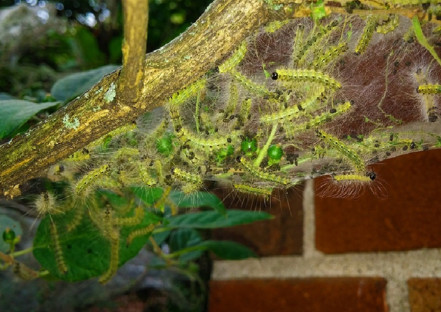
You may have noticed large, silky webs with caterpillars inside your trees and bushes lately. These are likely created by fall webworms (Hyphantria cunea).
In this post, we will discuss some natural ways to get rid of them. We will also provide tips on preventing them from taking over next year.
What Are Fall Webworms?
Fall webworms are often mistaken for eastern tent caterpillars, which mainly appear in spring. However, you can find fall webworms throughout much of the United States and Canada from late summer to early fall.
They’re the larvae of a moth [1], and they build noticeable webs in ornamental trees and shrubs.
The good news is that they’re not harmful to people or pets. The bad news is that they can be a real nuisance, eating the leaves of many trees and bushes.
Although severe infestations can cause noticeable defoliation, healthy established trees usually recover without long-term damage.
Identification
These caterpillars are easy to spot. They usually have pale yellow or greenish bodies covered with long white or gray hairs [2].
Fall webworms also occur in two forms: a red-headed form and a black-headed form.
The nests are made of silk. The caterpillars use the webbing to protect themselves from predators and harsh weather while they feed on leaves.
You’ll mostly see fall webworm nests on leaves at the ends of branches.
They feed on the leaves of more than 100 species of deciduous trees, including pecan, walnut, persimmon, hickory, oak, and sweetgum.
Adult fall webworm moths are primarily white, with hairy bodies. Some also have dark spots on their wings.
How to Get Rid of Fall Webworms Naturally
These pests are not the pickiest eaters, but there are a few things you can do to keep them away or make your yard less appealing to them.
If you’re wondering how to get rid of fall webworms in trees, the natural methods below can help reduce infestations and limit damage.
1. Parasitic Wasps
These wasps are natural enemies of webworms. They lay eggs inside the pests’ bodies. The eggs hatch and eat the caterpillars from the inside out.
Sounds pretty gross. However, it’s a natural way to help reduce webworm populations over time.
You can attract predatory wasps by providing them with water and planting flowers and herbs to which they are attracted.
2. Birds
Another way to keep webworms out of pecan trees, fruit trees, and others is to attract birds to your yard.
Some birds feed on fall webworms, especially when the caterpillars are exposed outside the webs. So put up a bird feeder or plant some trees and shrubs that will provide them with food and shelter.
You can also make your own DIY bird feeder. There are lots of different tutorials online, so you can choose the one that’s best for you.
And don’t forget to put out some fresh water for the birds to drink, too!
3. Spinosad
You may have seen these little critters in nests on your trees this fall. But before you reach for the toxic pesticides, consider using a natural product like spinosad.
Spinosad is derived from a natural soil bacterium. It can help control fall webworms and many other garden pests when applied according to the label directions.
4. Bacillus thuringiensis (Bt)
Bacillus thuringiensis is a good choice for controlling webworms if you have an infestation.
It is available in several formulations and can be purchased online or at many garden centers. It kills the caterpillars by forming holes in their gut walls.
Once they eat the Bt, they will die within a few days.
5. Neem Oil
Another excellent natural fall webworm treatment is neem oil. This is an all-natural product that is effective against many pests, including fall webworms.
You can buy a ready-to-use neem oil solution at most garden stores.
Or, you can make your own webworm spray. Just mix 1 tablespoon of cold-pressed neem oil and 1 teaspoon of mild liquid soap with 1 gallon of water.
6. Poke Holes in the Nests
You can also kill webworms organically by poking holes in their nests. Doing this will expose them to predators, such as birds and wasps.
7. Soapy Water
Another excellent home remedy for webworms is a soap-and-water mixture.
Fill a bucket with a mixture of dish soap and water. The ratio is two tablespoons of dish soap to a gallon of water.
Next, pull down the branch with the nest and submerge it in soapy water.
You can also put the soapy water into a spray bottle and spray the mixture onto the webs. Additionally, you can spray the mixture directly onto exposed caterpillars after opening or damaging the web.
The soapy water can help kill exposed webworms on contact.
8. Pruning
Pruning affected branches can help control fall webworms.
Prune small, infested branches when practical. However, avoid excessive pruning, especially on mature trees.
Once the branches fall to the ground, stomp on the nests to squish the caterpillars. Removing small infested branches may help reduce webworm populations and limit further damage.
9. Remove and Destroy Webs
Small webs can be removed by hand, clipped out, or knocked down with a pole. Destroying the nests early can prevent the caterpillars from spreading throughout the tree.
It is an excellent fall webworm control method that does not involve toxic chemicals.
10. Azadirachtin-Based Insecticides
Debug Tres insecticide is a natural webworm killer. This product contains azadirachtin and neem oil, and it is effective against a variety of pests.
All you need to do is mix it with the appropriate amount of water, then spray it onto the affected areas.
11. Horticultural Oil
Finally, you can use horticultural oil or dormant oil. This is a good brand, and it’s safe to use, even if the affected trees are close to your house.
It functions as an insecticide by suffocating insect pests.
Horticultural oils can help control exposed larvae and eggs if applied thoroughly. But they might not be as effective against caterpillars that are sheltered inside large nests.
Follow the instructions on the bottle.
See also: How to Get Rid of Sod Webworms in the Lawn.
How to Prevent Fall Webworms Next Year
- Remove and destroy webs as soon as you spot them.
- Rake up and dispose of fallen leaves beneath infested trees.
- Encourage beneficial insects and birds.
- Monitor susceptible trees during summer and early fall.
- Keep trees healthy with proper watering and care.
Takeaway
So, you’ve discovered fall webworms in your garden and on small trees in your yard, and you’re not sure what to do.
The home remedies and natural products listed above can help eliminate or control the problem in various ways.
Try one or more of these methods to reduce webworm populations and minimize damage to your trees and shrubs.




Add comment