

 Sasha Campbell
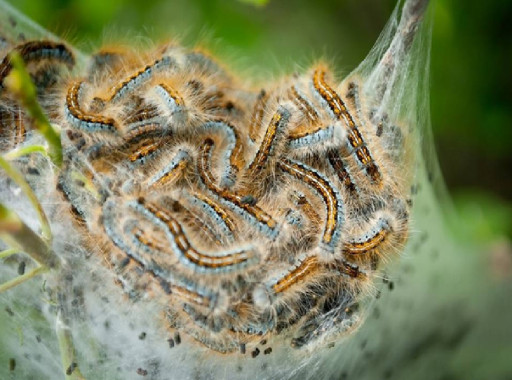
Ever notice those large, silvery-gray, tent-like webs in the forks and crotches of trees around your yard? No, it’s not spiders—it’s most likely Eastern tent caterpillars.
These little critters can do a great deal of damage to trees and shrubs if you let them get out of control. The good news is that you don’t need to douse your yard with chemicals to get rid of tent caterpillars.
You can try several natural methods to eliminate these pests and their unsightly tents. This article explores easy, natural solutions for tent caterpillar infestations.
Identification
Tent caterpillars are those fuzzy little critters that build silken nests (some build silken mats) in the branches of trees.
As larvae of moths, tent caterpillars feed on trees like cherry, apple, oak, and plum [1]. If you see webbing in your trees and groups of caterpillars crawling around on the trees, you likely have a tent caterpillar infestation.
There are a few common types of tent caterpillars you may encounter. The most well-known are the Eastern tent caterpillar, the Forest tent caterpillar, and the Western tent caterpillar.
How to Get Rid of Tent Caterpillars Naturally
Below are some home remedies and natural methods to control these hairy caterpillars.
1. Diatomaceous Earth
This product is a natural powder that dehydrates and kills tent caterpillars. When tent caterpillars come into contact with it, it scratches and dehydrates their bodies.
Apply the powder directly to the caterpillars and the areas where they crawl.
As an alternative, make a spray with diatomaceous earth and water. Use it to spray their colony and the critters themselves.
2. Spinosad
Spinosad is a natural insecticide that targets chewing insects, such as tent worms. It disrupts their nervous systems, causing paralysis and ultimately death.
Purchase spinosad concentrate and mix according to the directions on the product label. Popular brands include Monterey Garden Insect Spray and Bonide Captain Jack’s Deadbug Brew.
Thoroughly spray the critters, their nests (or mats), and the surrounding foliage.
3. Vinegar
One effective homemade tent caterpillar treatment is vinegar spray. The acid in vinegar naturally deters the caterpillars and can kill them on contact.
Therefore, mix two tablespoons of white vinegar with one gallon of water. Spray this home remedy directly on the caterpillars.
4. Homemade Pepper Spray
Another great home remedy for many pest problems is pepper spray. It can be an effective natural pesticide against tent caterpillars.
Make a spray by blending 10 fresh, hot peppers, such as jalapeños or cayenne peppers, and adding them to a gallon of water.
Next, heat the peppery water to release the peppers’ oils. Afterward, let it cool.
Finally, strain out the solids and add a few drops of dish soap to the solution to help the spray stick to the caterpillars. Spray it directly onto the critters.
5. Neem Oil
Neem oil is an organic pesticide that you can use against caterpillars in your garden and other areas outside your house.
To make a DIY tent caterpillar spray with neem oil, combine 2 ounces of pure neem oil, 1 tablespoon of dish soap, and 1 gallon of water. Next, shake it up and spray the affected areas.
6. Pruning
Pruning infested branches and leaves is an easy way to manually remove tent caterpillars from trees.
Go out and look for the nests in trees, especially in spring and early summer. Look for nests in the branches of susceptible trees, such as crabapples, cherries, and apple trees.
Once you spot an active nest, prune the branch it’s on. After pruning, dispose of the branches, leaves, and nests.
7. Pick Them Off
As the caterpillars hatch, check tree branches for nests or mats and destroy them. Also, search for and manually remove their egg cases.
Use a pruning shear to cut the branch holding the tent or mat, so it falls to the ground. Once on the ground, destroy or dispose of it in a bag.
You can also scrape off the eggs that the adult moths lay. Use a putty knife or something sturdy, and drop the egg cases into a bucket of soapy water to suffocate the eggs inside.
8. Natural Predators
Many natural predators prey on tent worms, helping control their populations.
Many birds will snack on the caterpillars, especially when they leave the tent to feed. Attracting birds is also good if the caterpillar nests are in tall trees.
Some bats will also eat caterpillars. Moreover, tiny wasps, such as the braconid wasp, lay their eggs inside caterpillars. The wasp larvae hatch and eat the caterpillar from the inside out.
Other natural enemies include ground beetles, ladybugs, and lacewings.
9. Bacillus thuringiensis
Bacillus thuringiensis (Bt) can also help control tent caterpillars. When the tent worms ingest Bt, they die within a few days.
You can find Bt in the form of sprays and drenches for plant application. The Bt kurstaki strain is most effective for tent caterpillars.
10. Soapy Water
One of the simplest methods to kill tent caterpillars and webworms is to thoroughly spray them with soapy water. Mix 2 tablespoons of liquid soap (Dawn dish soap is okay) into a quart of water in a spray bottle.
The soap will suffocate the caterpillars by coating them in a film and clogging their breathing holes. However, spray enough directly onto the caterpillars so it thoroughly soaks them.
You can also drown the critters in a container with soap and water.
11. Horticultural Oil
Use a horticultural spray oil like Bonide® All Seasons to suffocate tent caterpillar eggs and moth larvae. This treatment is a very effective organic control method.
Apply the spray oil according to the directions when you spot the caterpillars or their webbing tents.
12. Stiky™ Tree Wrap
These tree wraps are an easy, natural way to control these hairy caterpillars. The wraps create a physical barrier around the trunk, preventing caterpillars from climbing upward.
Follow the instructions that come with your purchase for applying it to the trees.
Takeaway
You’re now armed with simple and natural ways to eliminate and control those pesky tent caterpillars in your yard.
You can win this battle without using harsh chemicals. You can go the DIY route with traps and repellents. Or, you can bring in natural predators, like birds, to help do the work.



Add comment