

 Sasha Campbell
If you’re unfamiliar with it, snow mold is a fungal lawn disease that thrives in the cold, damp environment created by melting snow. It can damage your lawn grass and, in some cases, even pose a hazard to your health [1].
So, how do you get rid of snow mold? There are a few natural ways, but it’s essential to be vigilant and take steps to prevent it from forming in the first place.
This article will provide tips for treating this fungal lawn disease and preventing it from recurring.
Identification
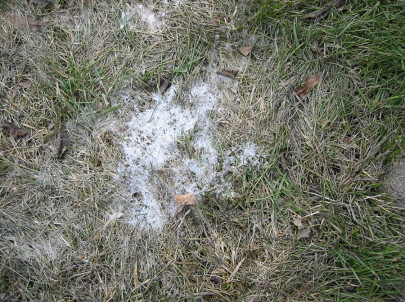
Snow mold typically appears as pink, gray, or white patches and can cause the grass to die if left untreated.
If you see any of the following signs in your yard, you likely have snow mold and should take action to remove it.
- Circles of straw-colored patches in the grass that range in different sizes.
- As the ground dries up, the patches on the grass take on a matted appearance and turn black, orange, or brown.
You’ll find snow mold in two types: gray and pink.
Gray snow mold appears as circular spots on the ground that resemble cottony growth [2]. Pink snow mold appears as circular dead spots/patches that can be pink, tan, or white. These patches also have a white center.
How to Get Rid of Snow Mold Naturally
1. Dethatch Your Lawn Regularly
To prevent snow mold, you should dethatch your lawn regularly.
Dethatching removes the thatch—the layer of dead grass, roots, and other organic matter that builds up on your lawn over time.
A buildup of thatch can create the perfect environment for snow mold to grow, so it’s essential to keep things in check.
You can rent a power rake or hire a lawn care professional to do it for you. Doing this will help control snow mold and improve your lawn’s health.
2. Avoid Fertilizing in Late Fall
Fertilizing in late fall is a no-no if you’re trying to avoid snow mold. Excess soil nitrogen can encourage snow mold growth.
So, even if you think you’re doing your lawn a favor by giving it a little extra TLC before winter, you might be doing more harm than good.
To be safe, wait until spring to fertilize your lawn again. Your grass will thank you.
3. Don’t Let Leaves Pile Up
You might be tempted to let the leaves fall where they may and deal with them in the spring, but that’s a bad idea. Allowing leaves to pile up can create the perfect environment for snow mold to grow.
So what can you do? You can rake them up or use a leaf blower to remove them.
You can also shred them for mulch with a lawn mower or chop them with a string trimmer. Either way, removing the leaves will help prevent snow mold from taking over your yard.
4. Don’t Let Snow Pile Up
If you want to avoid snow mold, one of the best things you can do is clear the snow away from your home as soon as possible.
I know it’s cold, and no one wants to go out in the snow, but if you let it pile up, it might turn into a moldy mess.
So, as soon as the snow stops falling, get out there and shovel it away from your foundation and any other areas where it might start to pile up.
5. Earthworm Castings
If you have earthworms in your garden, you’re in luck. Earthworm castings are an excellent way to reduce most lawn diseases and are also great for your plants.
Earthworm castings can be applied to the affected area. The castings will help break down the snow mold and improve the quality of your soil.
You can still use their castings even if you don’t have earthworms in your garden. You can purchase them online or at a gardening store.
6. Compost Tea
Compost tea is an excellent home remedy for reducing white fungus on grass and other lawn diseases.
It’s also easy to make. All you need is compost, water, and a little time.
To make compost tea, add a few scoops of compost to a container with water and let it steep for 24 hours. Then, apply the tea to the affected areas.
7. Hydrogen Peroxide
Hydrogen peroxide is a natural disinfectant that kills mold spores.
Mix one cup of hydrogen peroxide with one gallon of water. This solution can be used to treat winter grass mold.
8. Baking Soda
Another home remedy is baking soda. Mix three tablespoons of baking soda with two tablespoons of liquid soap, then add to a gallon of warm water.
Next, use it to spray affected lawn patches. This DIY solution will kill the mold.
9. Captain Jack’s Lawnweed Brew
This product is made with hydrogen peroxide and another formula shown to be effective against this cold-weather fungus.
Purchase it and use it as instructed in the instructions that come with your order.
10. Sil-Matrix LC
This organic fungicide helps prevent snow mold from taking hold.
It creates a protective barrier on the turf. Sil-Matrix LC is also effective against powdery mildew and rust. It can also be used on orchids and other plants.
11. ZeroTol HC
This is another excellent product for snow mold control.
To use ZeroTol HC as a snow mold fungicide, mix it with water as directed and apply it to the affected areas. You can use it as a surface treatment or foliar treatment.
Takeaway
If you suspect you have snow mold, you must take action quickly. You can try some of the natural remedies mentioned above, but it’s always best to consult a professional before using any treatment.
These simple steps allow you to keep your lawn healthy and free of snow mold.




Add comment